
A view of Prof. Ruggero Maria Santilli, in June 2008, at age 73 (photo by the the Italian magazine QuattroRuote, reproduced under copyright authorization). For additional pictures, visit photo album
Summary
In this article, we first review the studies conducted over the past three decades on the covering / generalization of
quantum mechanics known as hadronic mechanics, according to studies initiated in 1978 by the Italian-American physicist Ruggero
Maria Santilli when at Harvard University under DOE support and completed thanks to contributions from mathematicians,
theoreticians and experimentalists around the world.
We then review Santilli's application of hadronic mechanics to Rutherford's synthesis of the neutron from a hydrogen
atom inside a star via a generalized bound state of a proton and an
electron; we review the available experimental evidence on the laboratory synthesis of neutrons from protons and electrons; and we outline
the possibility of stimulating the decay of the neutron, with possible applications to a basically new form of nuclear energy known as hadronic energy, as well as to the recycling of nuclear waste via its stimulated decay.
In view of the environmental application of the studies, the article includes a retrospective view suggesting
the achievement of a technical knowledge of the new mechanics prior to venturing
judgments via the old quantum mechanics due to its inapplicability to the synthesis of the neutroin from a proton and an electron identified in detail in the presentation. The article then ends with a forward
view on the application of hadronic mechanics for the prediction and quantitative treatment of
new energies at the particle, nuclear and molecular levels,
with particular reference to energies that cannot be predicted or treated via quantum mechanics.
The reader should be aware that this is a review article without claims of scientific novelties or priorities, except for
a presentation of Santilli's advanced studies in a form more understandable to the average scientist.
EDITORIAL NOTE: This article is also printed in Tex/Latex format in Hadronic Journal 31, 1-123 (2008). Due to the limited capacities of the htlm format in writing formulae, interested reader are suggested to consult the above quoted regular publication for clarity.
Table of Contents
1. Rutherford's conception of the neutron
2. Scientific and environmental importance of Rutherford's legacy
3. The unreassuring gap between academia and the military-industrial complex
4. Santilli's lifelong research on the neutron structure
5. Conditions of exact validity of quantum mechanics
6. Conditions of approximate validity of quantum mechanics
7. Approximate validity of quantum mechanics in nuclear physics
8. Effectiveness of quantum mechanics for nuclear fissions
9. Ineffectiveness of quantum mechanics for nuclear fusions
10. Santilli's intermediate controlled nuclear fusions
11. Inapplicability of quantum mechanics for the synthesis of neutrons from protons and electrons
12. Insufficiencies of the neutrino hypothesis for the neutron synthesis
13. Insufficiencies of the quark hypothesis for the neutron synthesis
14. Incompatibility of the neutron synthesis with the cold fusion
15. Quantum mechanics
16. Invariance of quantum mechanics
17. Theorems of catastrophic inconsistencies of nonunitary theories
18. The physical origin of Santilli's hadronic mechanics
19. Hadronic mechanics
20. Santilli iso-, geno- and hyper-mathematics
21. Simple construction of hadronic mechanics
22. Invariance of hadronic mechanics
23. Direct universality of hadronic mechanics
24. Uniqueness of hadronic mechanics
25. Summary of pre-requisites for the Rutherford-Santilli neutron
26. Rutherford-Santilli neutron
27. Continuous creation of matter in the neutron synthesis and new longitudinal communications in space?
28. Don Borghi experiment on the synthesis of neutrons from protons and electrons
29. Santilli experiment on the synthesis of neutrons from protons and electrons
30. The Don Borghi-Santilli neutroids
31. Interpretation of Don Borghi and Santilli experiments
32. How to fake Don Borghi and/or Santilli experiments
33. The stimulated decay of the neutron
34. Neutron stimulated decay via photons with resonating frequency
35. Hadronic energy
36. Tsagas experiment on the Stimulated Neutron Decay
37. Santilli Experiment on the Stimulated Neutron Decay
38. Recycling of radioactive nuclear waste via their stimulated decay
39. Nuclei as hadronic bound states of protons and electrons
40. Backward and forward closing comments
41. Criticisms of hadronic mechanics and their lack of credibility
42. Acknowledgments
NOITE ADDED IN PROOF: Identification of isoquarks with physical particles
References
1. Rutherford's conception of the neutron
The neutron was conceived in 1920 by H. Rutherford [1] as a "compressed hydrogen atom" in the core of a star.
In essence, Rutherford noted that stars initiate their lives as sole aggregates of hydrogen atoms and end their lives
following the synthesis of all known matter. Hence, Rutherford submitted the hypothesis that the first synthesis inside tars
is that of a neutral particle from a proton and an an electron he called "neutron," after which stars progressively synthesize
all known matter.
The existence of the neutron was confirmed twelve years later by J. Chadwick [2]. However, the synthesis
of the neutron from a proton and an electron soon became the origin of controversies unresolved to this day. In fact,
W. Pauli [3] pointed out that quantum mechanics does not allow the representation of the spin 1/2 of the neutron via
a bound state of two particles, the proton and the electron, each having spin 1/2.
E. Fermi [4] then submitted the hypothesis that a massless particle (herein denoted with the symbol v) he called
"neutrino" (meaning "little neutron" in Italian) is emitted at the time of the synthesis of the neutron
according to the particle reaction
Fermi's neutrino and antineutrino were recently incorporated in the so-called standard model of elementary
particles (the literature in the field is so vast to discourage partial references). This inclusion required
progressive generalizations of Fermi's original conception of the neutrino, resulting in a field that is
vastly unsettled at this writing as shown below.
2. Scientific and environmental importance of Rutherford's legacy
The synthesis of the neutron inside a star is, by far, one of the most important events in nature that, being at the foundation of the creation of all matter, has fundamental scientific relevance for pure and applied mathematics, theoretical and experimental physics, astrophysics and cosmology.
In particular, it is easy to predict that all theoretical and experimental studies conducted to date on nuclear syntheses, including the "cold," the "hot" and the novel "intermediate" fusion (see below), are and will remain in a kind of suspended animation until we reach a complete theoretical and experimental understanding of the truly first and most fundamental fusion of them all, that of the neutron.
On environmental grounds, the neutron is one of the largest reservoirs of energy available to mankind because it decays into the proton, a highly energetic electron with the energy of at least 0.78 MeV (that can be easily captured via a metal shield) and the anti-neutrino (that is innocuous, assuming it exists),
Since the above decay is spontaneous (when the neutron is isolated or a member of certain nuclei), it is quite plausible to expect that the neutron admits some form of stimulated decay with far reaching possible implications for mankind, because such a stimulated decay could allow the development of a basically new form of energy (because originating in the structure of the neutron, rather than of nuclei), not to exclude the possible stimulated decay of the highly radioactive nuclear waste that could render nuclear power environmentally acceptable.
To put it bluntly, there is no mathematical, theoretical and experimental research nowadays that can be compared, even minimally, for significance and potential development, with mathematical, theoretical and experimental research on the synthesis of the neutron as occurring in stars.
Despite such a significance, studies on Rutherford's legacy (herein referred to the conception of the neutron as a bound state of a proton and an electron at mutual distances of 1 fm = 10-13 cm) have been solely conducted until recently by a limited number of courageous scholars because Rutherford's legacy is incompatible with Einsteinian doctrines, quantum mechanics and the standard model of particle physics as currently formulated, although not if properly reformulated, as shown below.
3. The unreassuring gap between academia and the military-industrial complex
The increasingly alarming environmental changes in our planet, on one side, and the incompatibility of their solutions with preferred doctrines, on the other side, are altering the traditional basic role of academia in the advancement of scientific knowledge.
Due to the evident lack of interest by academia at large (with due exceptions) on Rutherford's legacy for evident reasons of political conflict with preferred theories, the industry has initiated large investments in the field, some of which predictably conducted under secrecy, if nothing else, to protect the research from nonscientific academic attacks. This trend is such that the journals of established physics societies are nowadays the very last conduits, if any, to identify basic advances in the field.
This article is intended to collect the information currently released by the industry and to provide the elements for interested academic as well as industrial physicists not to remain behind industrial developments. The understanding is that this article provides a mere conceptual outline, although including the most important references for a technical study of the topic that, as we shall soon see, is quite advanced and definitely post Ph. D. level in mathematics and physics. Additional information will be added at some future time when released by the industry.
It is appropriate to recall that the U. S. military decided in the mid 1970s to terminate the direct support of academic research, and to conduct their own research in secrecy. This decision originated the birth of ERDA that became the U.S. Department of Energy. A comparison of the very large differences between the incredible scientific and technological advances achieved by the U.S. military since that time, and the comparatively minuscule "basic" advances achieved by academia (if any) illustrates the value of the decision by the U. S. military for the very protection of the United States of America.
The origin of this clear disparity is that research by the U. S. military is conducted without any restriction of compatibility to a preferred theory, whereas the entirety of the so-called orthodox research conducted by academia has been strictly and rigidly restricted to comply with Einsteinian doctrines and quantum mechanics.
Academia does not appear as being aware that the industry is now following the example of the U. S. military with the conduction in secrecy of basic research, that is, research beyond Einsteinian doctrines and quantum mechanics. As a consequence, a number of industrial research contracts nowadays mandate lack of disclosure of basic advances particularly to academia, and at times new products are nowadays released into the market by carefully avoiding the disclosure of possible novelties over Einsteinian doctrines in their development.
The research herein reported began in academia (at Harvard University under full DOE support, as recalled below), but had to be completed outside academia under industrial support because of incredible obstructions by academia due to the indicated conflicts with established doctrines.
Nowadays, contributions by academia are no longer necessary for basic advances in Rutherford's legacy since the industry is well launched toward its mathematical, theoretical and experimental resolution. As a result of this trend, the original gap between the U. S. military and academia has now a corresponding gap between the industry and academia.
Yet, the increasing gap between academia and industry is unreassuring and should be reduced via the active participation by academic scientists on truly basic advances because the environmental problems facing our planet are of such a dimension to require indeed a collegial participation by all scientists, irrespective of whether the research is or is not aligned with known interests on Einsteinian doctrines and quantum mechanics.
It is hoped this article will influence academic as well as non-academic scientists not to remain behind industrial advances on one of the most fascinating, fundamental and unsolved problems of current scientific knowledge, the synthesis of the neutron inside stars.
Qualified mathematicians, theoreticians and experimentalists interested in applying for industrial research funds may contact the Institute for basic Research at ibr@gte.net. Please note that the sole funds available are on the synthesis of the neutron along the lines of this paper. For different approaches interested scientists may apply for funds elsewhere.
4. Santilli's lifelong research on the neutron structure
The most comprehensive research on the synthesis of the neutron as it occurs in stars, from protons and electrons, has been conducted by the Italian-American scientist Ruggero Maria Santilli over four decades of research (see his Curriculum).
Santilli achieved the highest possible Ph. D. education in Italy in pure mathematics, physics and chemistry where he achieved at a very young age the chair of nuclear physics at the Avogadro Institute in Turin.
Next, Santilli moved to the U.S.A. in 1967 with his wife Carla and (then baby) daughter Luisa following an invitation from the University of Miami in Coral Gables for conducting research under NASA financial support.
During this appointment, Santilli wrote the first known papers on the so-called Lie-admissible generalization of Lie's theory [5] for which he later received the nomination by the Estonia Academy of Science among the most illustrious applied mathematicians of all times, including Weyerstrass, Fermat, Newton, Hamilton, Lie and others (the only Italian name in the list) [5]. By recalling that Lie's theory is at the foundations of conventional quantum mechanical bound states, Santilli's structural generalization of Lie's theory identifies his clear research goals since the late 1960s.
Following his stay at the University of Miami, Santilli assumed the positions of Assistant and then Associate professor of Physics at Boston University where he taught courses in mathematics and physics from prep courses all the way to Ph. D. courses and then post Ph. D. seminar courses on topics at the forefront of knowledge.
During this period, Santilli conducted research under support from the U. S. Air Force and became a U. S. Citizen. Subsequently, he left Boston University for a stay at the Institute for Theoretical Physics of MIT and then joined the Lyman Laboratory of Physics at Harvard University on September 1, 1978.
Since 1985, Santilli is the President of the Institute for Basic Research (http://www.i-b-r.org), an international 'think thank' of scholars in various fields. Santilli is also the founder (jointly with C. N. Yang, I. Prigogine, N. N. Bogoliubov and other famous scientists) of the Hadronic Journal, that has been regularly published since its initiation in 1978. This is one of the few scientific journals publishing (at no cost) refereed papers beyond Einstein and quantum mechanics (see Hadronic Press).
On the very day of his arrival at Harvard (September 1, 1978), the Department of Energy (then ERDA) contacted Harvard's administration inviting a grant application from Santilli for the specific objective of studying a broadening of quantum mechanics suitable for quantitative studies of new clean energies and fuels.
This invitation lead to the following research contract from the D. O. E. ER-78-S-02-47420.A000, AS02-78ER04742, DE-ACO2-80ER10651; DE-ACO2-80ER-10651.A001, and DE-ACO2-80ER10651.A002; administered by harvard University with Santilli as co-principal investigator jointly with S. Sternberg as the senior member requested by Harvard internal rules.
Thanks to the D. O. E. financial as well as academic support, Santilli initiated his research under said contracts with the publication in 1978 of two long memoirs [6,7] dedicated to the proposal to build the new hadronic mechanics as a covering of quantum mechanics specifically conceived for the synthesis of the neutron from protons and electrons, The first memoir [6] presenting a structural generalization of the mathematics underlying quantum mechanics, and the second memoir [7] presenting the fundamental physical law of hadronic mechanics, as well as their first consistent application to the structure of mesons as generalized bound states of massive particles produced free in spontaneous decays.
Historical memoirs [6,7] stimulated a world wide interests as well as a large research effort that included five Workshops on Lie-Admissible Formulations held at Harvard University, eighteen Workshops on Hadronic Mechanics held in numerous countries, and various International Conferences on Hadronic Mechanics held in the U.S.A., Europe and China. This research effort resulted in over one thousand technical articles, some thirty post Ph. D. level monographs in hadronic mathematics, physics and chemistry, and some 60 volumes of conference proceedings for an estimated total of over 20,000 pages of published research.
There is no possibility for us but to quote only the most important papers out of this so vast a scientific production. At this moment, we are regrettably forced to quote Santilli's monographs [8-27] and representative monographs [28-33] by independent scholars carrying Santilli's name in the title. The 90 pages long general bibliography in the field is presented in Volume [21].
Following such a vast effort, Santilli finally achieved in 1990 [35] at the Institute for Basic Research in Florida the first nonrelativistic, numerically exact and invariant representation of ''all" characteristics of the neutron as a hadronic bound state of a proton and an electron.
The corresponding relativistic, exact and invariant representation of all characteristics of the neutron synthesis was achieved
by Santilli [36] in 1993 while visiting the Joint Institute for Nuclear Research in Dubna, Russia, and then again in 1995 [37] while visiting the Academia Sinica In Beijing, China. Subsequently, Santilli conducted comprehensive experimental verification of the laboratory synthesis of the neutron from protons and electrons reviewed below. A detailed and updated presentation of the mathematical, theoretical and experimental studies on the neutron synthesis is available in Volume [24].
It should be indicated that, as soon as the necessity to surpass Einsteinian doctrines and quantum mechanics became obvious, the academic obstructions at Harvard University against Santilli's research became so strong, to force Santilli to leave Harvard University despite the availability of a large DOE support. After leaving Harvard, Santilli took the Presidency of the Institute for basic Research that was originally located at the Prescott House inside harvard's compound.
The opposition by organized interests on Einsteinian doctrines and quantum mechanics in the Cantabridgean as well as the Boston Area became very strong, by forcing Santilli to leave the area never to return for the rest of his life, and moving the Institute for Basic Research to Florida where it is in full operation..
Santilli had the courage of reviewing these academic obstructions up to 1984 in book [26] with three volumes of documentation made available in Refs. [27] of 1985 (now all available as free pdf downloads from the websites indicated in Refs. [26,27]). Truly incredible acts of scientific misconducts by organized interests on Einsteinian doctrines and quantum mechanics following 1984 have been courageously presented and documented by Santilli in volume [21-25] (see Volume [24] in particular).
It is hoped the above documentation of organized scientific misconduct by academia against a scientist just because of his professional search of undesired new scientific knowledge, when multiplied by similar occurrences experienced by all scientists around the world who dared to go beyond Einstein, illustrates the statement in the preceding section to the effect that, nowadays, academia, their physics societies and their related journals are no longer the place for basic advances on fundamental issues, such as that of the neutron synthesis. Different views can only be proffered by naive and uninformed people or by accomplices.
Fortunately for mankind, the industry took over the support of Santilli's research because of clear novel industrial applications that are now continued by public companies in the USA, England and India (visit, for instance, http://www.magnegas.com) and have made Santilli a wealthy man (only his collection of ferraris and other classic cars is estimated to be worth several millions of dollars). In view of his scientific and industrial achievements, Santilli has received several nominations for the Nobel prize in physics and, separately, in chemistry, as well as numerous other honors.
The courageous take over of the funding by the industry, despite such an organized academic obstruction, illustrates the increasing gap between basic research in the industry and academia, as well as the indicated need for the industry to conduct its basic research under condition of not being disclosed to academia.
5. Conditions of exact validity of quantum mechanics
One of Santilli's first scientific contribution has been the conduction of professional studies at the Department of Mathematics of Harvard University under DOE support for the technical identification of the conditions for which quantum mechanics is exactly valid, approximately valid, and inapplicable.
Quantum mechanics is exactly valid for all conditions of its original conception, consisting of particles moving in vacuum at sufficient mutual distances to allow their effective point-like approximation. Quantum mechanics is also exactly valid for electromagnetic waves propagating in vacuum. (see Ref. [21] for technical details).
This conclusion is based on an in depth analysis of the structure of quantum mechanics, beginning from its local-differential topology, that solely permits the representation of particles as dimensionless points.
Despite such a structural limitation, quantum mechanics is exactly valid for a variety of physical systems meeting the above requirement, such as the structure of the hydrogen atoms, all crystals, all particles in accelerators, and numerous other physical events in which the theory achieves numerical representations of incredible accuracy without ad hoc parameters.
6. Conditions of approximate validity of quantum mechanics
Quantum mechanics has been proved to be approximately valid for particles at mutual distances of the order of the size of their charge distributions and/or wavepackets, namely, for conditions under which the point-like abstraction of particles is no longer effective [21].
The mathematical basis for the above insufficiency is given by the above identified impossibility for quantum mechanics to represent particles as they are in the physical reality,
The physical basis for the above insufficiency is that the representation of data for extended particles (such as protons and neutrons) at short mutual distances is no longer derived from unadulterated axioms, but generally requires the use of free parameters that, in reality, are a representation of the deviations of the basic axioms of quantum mechanics from physical reality.
An incontrovertible illustration is given by the Bose-Einstein correlation that consists of protons and antiprotons colliding at very high or small energies, combine into the so-called "fire ball" that spontaneously decomposes into an array of unstable particles whose final constituents are correlated mesons and other particles.
The representation of the experimental data via quantum mechanical two-point functions has required four free parameters of unknown origin (called "chaoticity parameters"). However, the Hamiltonian for the two-point function is diagonal and two dimensional. As such, one could only introduce two parameters. The additional two parameters require off-diagonal terms that are in irreconcilable contrast with the quantum axiom of expectation value of observable (thus Hermitean, that is, diagonal) quantities (see volume [24], Section 6.1 for details).
In the above, and quite numerous other cases, ad hoc parameters are just thrown into the equations and quantum mechanics is claimed to be exact, but this is the case only on political grounds. For rigorous proofs of the impossibility for quantum mechanics to be exact (but still remaining approximately valid) for the Bose-Einstein correlation and numerous other cases of the conditions herein considered, see Volume I, Chapter 1, and Volume IV, Chapter 6 of [24].
Another main reason for the loss of credibility by academia, their physics societies and their journals for the study of new energies is precisely the suppression of any scientific process, let alone the admission of the limitations of quantum mechanics. Lacking the scientific process on the limitations of preferred doctrines, no basic advance is conceivably or credibly possible.
By comparison, industrial investments have no allegiance to Einsteinian or any other doctrines, thus allowing the admission of their limitations when professionally established, hence setting up the premises for truly basic advances in scientific knowledge. The much bigger credibility of industrial over academic research on truly basic issues is then beyond any possible or otherwise credible doubt.
7. Approximate validity of quantum mechanics in nuclear physics
Another reason for the loss of scientific credibility by academia due to the excessive dominance of political interests over scientific veritas, has been the lack of admission for over half a century of the merely approximate character of quantum mechanics in nuclear physics.
Santilli became a physicist because, during his high schools studies in Italy in the 1950s Albert Einstein was voicing his doubt on the "lack of completion" of quantum mechanics, Enrico Fermi was expressing doubts as to whether conventional geometries and mechanics are valid in the interior of nucleons, and other authoritative doubts on the final character of quantum mechanics were expressed at that time, thus flaring up the imagination of young students such as Santilli.
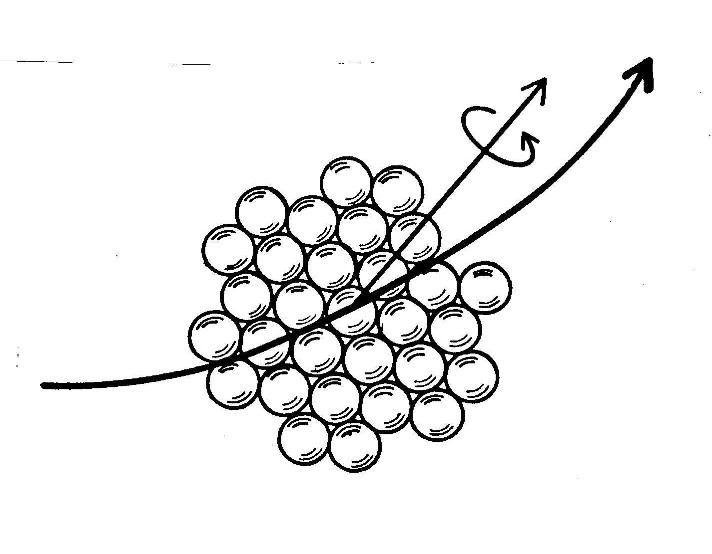
Academia, their physics societies and their journals have lost scientific credibility in nuclear physics because they allowed the take over of political interests and suppressed for over half a century any scientific advance over quantum mechanics in nuclear physics.
On serious scientific grounds, Santilli recalls that a theory can be considered as being exactly valid only when it represents all experimental data from un-adulterated basic axioms. Whenever a theory cannot represent "all" data, or their representation requires manipulations such as throwing in unknown functions and parameters, that theory cannot possibly be exact in the field considered. The selection of the appropriate broader theory is, of course, open to scientific debates, but not its need.
The loss of credibility by academia in nuclear physics stems from the fact that quantum mechanics has been unable to represent even basic aspects of even the simplest possible nucleus, the deuteron, despite research for about one century under a river of public money. In fact [21]:
1) Quantum mechanics has been unable to understand the spin 1 of the deuteron, because quantum axioms mandate that the ground state of two particles with spin 1/2, the proton and the neutron, must be 0 for stability (singlet coupling with antiparallel spin).
2) Quantum mechanics has been unable to represent the magnetic moment of the deuteron due to about one percent still missing despite all possible relativistic corrections (quark conjectures being basically unable to help since their hypothetical orbits are too small to be polarized).
3) Quantum mechanics has been unable to explain the stability of the neutron when a member of the deuteron, since the neutron is naturally unstable and decays spontaneously in about 14 m.
The above basic insufficiencies are for the simplest nucleus, mind you. When passing to more complex nuclei, the deviations of the nuclear data from quantum predictions become bigger, to reach truly embarrassing disagreement for heavy nuclei such as zirconium.
As an indication, the disagreement between the prediction of quantum mechanics for magnetic moments of large nuclei and the experimental data can be of the order of 60% or more, with similar embarrassing deviations for virtually all structural data.
By far the largest failure of quantum mechanics in nuclear physics has been the impossibility to achieve an exact representation of nuclear forces. Since nuclear forces bind together the nucleons in a nucleus, all research crucially dependent on nuclear forces, including the hot and cold fusions, are in a state of suspended animation, any firm statement in favor or against being purely political.
The first political constraint in contemporary academia is that quantum mechanics is exact in nuclear physics. But quantum mechanics represents physical systems with the sole knowledge of the Hamiltonian H. hence, the second political constraint is that nuclear forces must be representable with a Hamiltonian. But the physically meaningful expressions of the Hamiltonian are those given by the sum of the kinetic and potential energies, H = p2/2m + V(r). hence, the third political constraint in academic research in nuclear physics is that "the nuclear force is derivable from a potential."
This sequence of political constraints (whose strict implementation is absolutely necessary to seek and/or keep an academic job and to try to publish a paper in academic conduits) mandated the continuous addition of potentials in the representation of the nuclear forces, evidently due to the insufficiency of the preceding ones.
This purely political process without serious underlying science has now surpassed all limits of scientific decency because nuclear forces have recently reached up to 35 different potentials without achieving their exact representation
This cannot possibly be science! There is a limit in the political handling of scientific knowledge beyond which all credibility is lost to such an extent of raising issues of possible violation of federal laws when the "research' is done with public funds [24].
It is evident that the above century old failure is due to the Hamiltonian character of the nuclear force. But such an admission mandates the abandonment of Einsteinian doctrines and quantum mechanics in favor of covering non-solely hamiltonian theories (see below). As such, the view is pure anathema in contemporary academia.
In the final analysis, protons and neutrons are literally in conditions of "contact" with each other when members of a nuclear structure. But then the existence of a nonpotential component in the nuclear force can indeed be denied with academic politics, but definitely not on scientific grounds (see below the very birth of hadronic mechanics).
In summary, the approximate character of quantum mechanics in nuclear physics is beyond doubt. However, equally beyond doubt is the lack of final character of quantum mechanics in nuclear physics, thus setting up the need for a more appropriate theory. After all, scientific history establishes that physics will never admit final theories.
All colleagues working on new nuclear energies via the use of quantum mechanics are warned that their efforts to date has produced no industrial results and the continuation of use of quantum mechanics for new nuclear energies is nowadays considered as being political for the reasons technically studied in volumes [21-25] and conceptually outlined below.
After all, an axiomatically consistent covering of quantum mechanics resolving the above limitations already exists. But then, its lack of consideration on a comparative basis with quantum mechanics is indeed political, and definitely not scientific.
8. Effectiveness of quantum mechanics for nuclear fissions
In approaching our main objective on energy related issues, it is important to indicate that quantum mechanics works well for all nuclear fissions, to such an extend that the practical value in developing a broadenings of quantum mechanics is very questionable for the field here considered.
The technical reasons have been identified by Santilli [21,23] and consists in the fact that nuclear fissions are generally triggered by particles such as neutrons that do indeed admit, for the case considered, an effective point-like approximation. The size and shape of irradiated nuclei is irrelevant for primary results, and the effectiveness of quantum mechanics for nuclear fission follows.
9. Ineffectiveness of quantum mechanics for nuclear fusions
The industrial utilization of nuclear fissions, as in the case of nuclear power plants, works well when conducted via quantum mechanics. Hence, quantum mechanics can indeed be considered as being valid and effective for nuclear fissions.
By comparison, despite a collective sum of public money from various countries estimated in excess of one hundred billion dollars over the past four decades, no industrially meaningful results has been achieved in the hot fusion, as well as in the cold fusion whenever elaborated via quantum mechanics. Hence, to avoid turning science into a political scheme, it is time to doubt the validity of the basic discipline.
Santilli has conducted comprehensive mathematical, theoretical and experimental studies in the issue and concluded that quantum mechanics is inapplicable for nuclear fusions (and not "violated" because not conceived for that scope) for numerous reasons.
To begin, any accurate representation of the fusion of two nuclei into a third
requires a representation of the actual features of the original nuclei, such as size, etc. But quantum mechanics can only represent the original nuclei as dimensionless points. Hence, the insufficiencies of quantum mechanics for nuclear fusions is beyond scientific doubt.
But there are deeper reasons identified by Santilli for the insufficiency. It is thought in first year physics courses that quantum mechanics is invariant under time reversal, -t, a property necessary for the exact representation of atomic orbits since they are all reversible in time. But all nuclear syntheses are irreversible in time, as well known, hence, any belief that a reversible theory such as quantum mechanics is exactly valid for structurally irreversible processes such as the cold fusion, is pure nonsense.
In fact, Santilli's graduate students have proved that, jointly with a finite probability for synthesis of two nuclei into a third, Eq. (4), quantum mechanics predicts a finite probability for the spontaneous disintegration of the third nucleus into the original ones
which is pure nonsense. There is no need to repeat the calculations because the probability amplitude for the fusion is time reversal invariant. Hence, it applies for both directions of time. Period. The rest is academic politics against scientific knowledge.
For numerous additional insufficiencies of quantum mechanics for any type of fusion process, one may study Volume [21] or paper [37].
10. Santilli's intermediate controlled nuclear fusions
Santilli has studied the above and numerous other [21] limitations of quantum mechanics for both the cold and hot fusion; has constructed the covering hadronic mechanics, specifically, for a comprehensive representation of all features of the nuclei to be fused; has identified seven physical laws to be verified for any chance of industrial results with nuclear fusions; has proposed his novel intermediate controlled nuclear fusion, [37] namely, a fusions operating by conception and technical realization at threshold energies varying from nuclei to nuclei, thus being generally bigger than the energy available in the cold fusion, but definitely smaller than those of the hot fusion, thus avoiding its lethal instabilities. Extensive experimentation is now available thanks to large industrial investments.
Regrettably, this new type of fusion cannot be reported here because technically quite advanced, and requires a separate article.
11. Inapplicability of quantum mechanics for the synthesis of neutrons from protons and electrons
While quantum mechanics is exactly valid for the structure of the hydrogen atom, and only approximately valid for the structure of the deuterium, Santilli [21,24] has established that quantum mechanics is inapplicable (and not violated) for any quantitative representation of the synthesis of neutrons as it occurs in stars, from protons and electrons, for numerous independent reasons, each one implying a catastrophic inapplicability, such as:
1) All consistent quantum mechanical bound states A + B = C, as they occur in atoms, nuclei and molecules, have a mass defect, namely, the rest energy of the bound state C is smaller then the sum of the rest energies of the original states A and B, resulting in the very principle for which nuclear fusions release energy. The above mass defect is represented by a negative binding energy in the Schroedinger equation for the bound state that, under these conditions, is fully consistent. By comparison, from Eqs. (1), the rest energy of the neutron is 0.782 MeV bigger than the sum of the rest energies of the proton and the electron. As a result, any possible treatment of the neutron synthesis p + e => n + ? would require a positive binding energy that is sheer anathema for quantum mechanics because, under such binding energies the Schroedinger's equations becomes physically inconsistent, without any possibility this time to add unknown parameters for the usual political aim of "fixing things" and adapting nature to a preferred theory.
2) It is popularly believed that the energy of at least 0.78 MeV missing in the synthesis of the neutron can be provided by the relative kinetic energy between the proton and the electron. This view has no serious scientific content, because the cross section of the proton and electron at 0.78 MeV mutual energy is extremely small (of about 10-20 barn) in which case any possibility for the proton and the electron to coalesce and form the neutron is impossible. As we shall see, this limitation can be resolved by assuming a participation of space as a universal medium known as aether, but this requires ab initio to exit from the boundary of quantum mechanics.
3) Assuming that, via hitherto unknown manipulations, incompatibilities 1) and 2) could be resolved, simple calculations via the use of quantum mechanics show that the electron can be retained inside the proton for extremely small periods of time (of the order of 10-15 seconds). But the neutron has a lifetime of about 14 minutes. Hence, the error by quantum mechanics in the representation of the lifetime of an isolated neutron is of the order of 10,000,000,000.000 fold!
4) Quantum mechanics does not allow the achievement of the spin 1/2 of the neutron via two particles, the proton and the electron, each having spin 1/2. As shown below, the Pauli-Fermi hypothesis of the emission of a neutrino in the synthesis, Eq. (1), is far from being settled, e.g., because the mechanism for a proton and an electron to a kind of "decomposing" themselves in order to produce the neutrino is vastly unknown.
5) Assuming that all the above incompatibilities (that are per se irreconcilable for all qualified physicists) are somewhat resolved, still quantum mechanics cannot represent the magnetic moment of the neutron from the known magnetic moments of the proton and the electron (see Santilli [3], Volume IV).
In summary, political supporters of quantum mechanics as the final theory of nature can manage to add unknown parameters, manipulate things, adjust unknown functions and do all sort of tricks to represent experimental data, and then conclude that "quantum mechanics is valid" for numerous cases. However, this manipulation of scientific knowledge is impossible for the neutron synthesis because no matter what manipulation can be dreamed up, no quantitative representation of the neutron synthesis is permitted by quantum mechanics.
In conclusion, the most fundamental synthesis of nature, the synthesis of neutrons from protons and electrons in the core of stars, cut out all politics on the final character of quantum mechanics, establishes the irreconcilable inapplicability of the theory. This establishes the need for a covering theory.
12. Insufficiencies of the neutrino hypothesis for the neutron synthesis
As recalled in Section 1, Pauli's objection on the inability to represent the spin 1/2 of the neutron according to Rutherford, led to Fermi's hypothesis of the neutrino according to Eq. (1).
Despite the success of the Pauli-Fermi hypothesis, Santilli has identified a litany of unresolved problems in the neutrino conjecture [21,24]. To begin, the neutrino conjecture has no explanation on how the proton and/or the electron experience a kind of "decomposition" to produce a neutrino.
The complementary hypothesis of the anti-neutrino via the reaction
is even more controversial than reaction (1) because the antineutrino has a null cross section with the proton and the electron. Consequently, there is no possibility whether, not even remote, that the antineutrino can deliver the 0.78 MeV needed for the neutron synthesis. hence, even assuming that conjecture (6) resolves the problem of the spin (which it does not), the problem of the missing 0.78 meV remains unsolved (Santilli, Loc. Cit.].
Additionally, recent studies (see monograph [19]) have established that the sole possibility for scientific democracy between matter and antimatter, thus including a consistent classical theory of antimatter, requires that the anti-neutrino has a negative energy although referred to a negative unit. Consequently, reaction (6) is predicted to require energy, rather than supply the missing 0.78 MeV.
Additionally, according to quantum mechanical bound state, hypothesis (6) would require that the neutron is a three-body bound state of a proton, an electron and an antineutrino, which view is pure nonscientific nonsense because there is no possibility whatsoever, not even remote, to permanently bound a neutrino inside the small volume of the proton as needed for the deuteron.
Additionally, Fermi's original hypothesis of one neutrino and one antineutrino has been more recently incorporated in the standard model and this has caused a proliferations of controversies that are increasing in time.
To begin, the standard model first required the increase from one neutrino and one antineutrino to three neutrinos (the electron, muon and tau neutrinos) and three antineutrinos that, for physical consistency, must be different, although no experimentally verifiable difference has been provided to date by academia [21,24].
Due to the insufficiency of this first generalizations, the neutrinos and antineutrinos were then assumed to have masses that, in reality, are free parameters introduced to "fix things." In fact, the "neutrino masses" are fitted from the experimental data and not derived from first independent principles of the theory.
Due to the insufficiency of the latter conjecture, it has been conjectured that neutrinos have different masses, and the chain of conjectures each one ventured in the hope of resolving a preceding unverifiable conjecture is continuing, thus turning science into a pure theology and academic manipulation.
Even the so-called "neutrino detections" are themselves very questionable in their very definition because neutrinos cannot be directly detected. Hence, the scientifically correct statement should be that the detections here here considered refer to physical particles predicted by the neutrino theory. But then, there are other theories without the use of the neutrino conjecture that interpret these "experimental data" [24].
The most implausible feature of the neutrino conjecture is that neutrinos are believed to traverse entire stars without any collision. This view was already questionable according to Fermi's original assumption that neutrinos are massless. Nowadays, the belief that massive neutrinos can traverse stars without collision has no scientific credibility whatsoever, being pure theology.
In summary, the conjecture on the existence of the neutrinos is extremely unsettled to this day, and plagued by a number of unresolved problems that increase, rather than decrease in time.
One can now begin to appreciate the importance of Santilli's theoretical and experimental studies on the neutron synthesis because they mandate the addressing of basic problems that would otherwise remain completely ignored. This feature also illustrate the extreme opposition by academia against the study of the neutron synthesis [26,27].
13. Insufficiencies of the quark hypothesis for the neutron synthesis
The biggest obstacles against the utilization of the energy contained in the neutron is the widespread belief that quarks are physical constituents of the neutron and of hadrons at large.
In fact, in the event quarks are the constituents of the neutron, no possibility exists or is conceivable for the utilization of the energy in its interior. On the contrary, if the electron is indeed a physical constituent of the neutron, said energy can indeed be utilized, as we shall see below, via its stimulated decay.
Santilli [21,24] accepts the SU(3)-color classification of hadrons as final; he recognizes that quarks are necessary for the technical elaboration of SU(3) theories; but Santilli's view is that quarks are purely mathematical representations, defined in a purely mathematical, complex-valued internal unitary space without any possible definition in our spacetime, for the following reasons:
1) According to quark believers, permanently stable particles, such as the proton and the electron, simply "disappear" at the time of the synthesis of the neutron inside stars to be replaced by the hypothetical quarks. This view is purely political without scientific credibility or backing [24].
2) Also according to quark believers, at the time of the spontaneous decay of the neutron, the proton and the electron simply "reappear" in the universe. In fact, according to the standard model, the proton and the electron are claimed to be "recreated" at the time of the neutron decay, although without any explanation whatsoever on how this might be possible. This belief is pure nonscientific nonsense intended to serve personal interest and definitely cannot be considered serious science [24].
3) Assuming that the above problems can be somewhat bypassed [24], Santilli has provided rigorous proof that, in the event the neutron is made up of quarks, it cannot have any gravity at all. In fact, as state by Albert Einstein, gravity can only be defined in our spacetime, while quarks absolutely cannot be defined in our spacetime, since they can only be defined in a mathematical complex-valued unitary space.
There are numerous additional technical reason for the impossibility of quarks to be physical particles in our spacetime. One of them is the very argument according to which quark believers dismiss the Rutherford-Santilli model of the neutron. The "argument" is that, according to quantum mechanics, Heisenberg's uncertainty principle does not allow the electron to be permanently bound inside the proton for the lifetime of the neutron. The politics in this case is established by the fact that the same argument is not used by quark believers to prove the impossibility for quarks to be permanently bound inside the neutron.
The understanding of the scheme is formalized by the fact that quarks are centrally based on the use of the conventional quantum mechanics for their very definition, while the Rutherford-Santilli electron obeys a covering of quantum mechanics. Hence, the "argument" based on the uncertainty principle definitely applies to quarks, and definitely has no sense for the Rutherford-Santilli electron.
14. Incompatibility of the neutron synthesis with the cold fusion
Physicists interested in preserving old knowledge, rather than seeking new knowledge, generally use the insufficiencies of the cold fusion as evidence for the impossibility of synthesizing neutrons from protons and electrons. This view should be disqualified, particularly when proffered by experts.
In fact, the neutron synthesis requires energy, while the cold fusion aims at producing energy. Consequently, the mathematical and physical laws that are effective for the former event have to be changed for the different features of the latter event.
Additionally, the synthesis of the neutrons occurs in stars from the sole use of protons and electrons. By comparison, the neutrons detected in certain cold fusions originate from nuclear synthesis, that is, the neutrons released in nuclear fusions occur from nuclear processes such as excess neutrons in the synthesized nucleus, and definitely not from protons and electrons.
In summary, the Rutherford-Santilli neutron is strictly referred to neutrons synthesized from the sole use of protons and electrons as occurring in stars. Any use of information from cold fusion, nuclear syntheses and the like, for the Rutherford-Santilli neutron is not scientific, irrespective of wether in favor or against said synthesis.
15. Quantum mechanics
The central equations of quantum mechanics for the time evolution of a physical quantity A(t), such as energy, angular momentum, etc., are given by Heisenberg's equations in their finite and infinitesimal form
plus the Schroedinger-eigenvalue equation for the energy and the linear momentum (with h-bar = 1)
where D represents hereon partial derivative with respect to r, and related canonical commutation rules
As one can see, quantum mechanics can solely represent systems admitting their complete interpretation via the sole> knowledge of the Hamiltonian
It should be indicated that the technical definition of "quantum mechanics" is not the above elementary one, but that including all infinitely possible classes of unitary equivalence of the above formulations, namely, all infinitely possible equations that can be constructed via
readers should be warned that the scientific literature is full of papers claiming to present "new mechanics" when in reality they are fully equivalent to quantum mechanics because they preserve the quantum axioms, as well as, in particular, the unitary character of the time evolution, Eq. (9).
The reader should keep in mind the fundamental role of Lie algebras with product [A, B], appearing in the bracket of the time evolution, and then characterizing virtually all physical quantities possessing a symmetry, such as pin.
16. Invariance of quantum mechanics
Quantum mechanics achieved a historical status because, in Santilli's words, it possesses a "majestic axiomatic structure." The roots of its consistency is given by its unitary structure, namely, that its basic time evolution constitutes a unitary transform on a Hilbert space, Eqs. (9).
The implications of this property are far reaching. To begin, the unit of the Euclidean space I = Diag. (1, 1, 1) generally represents in an abstract way units actually used in the experiment, such as I = Diag. (1 cm, 1 cm, 1 cm). Consequently, the unitary character of the time evolution law of quantum mechanics implies the preservation of the basic units in time,
Additionally, a quantity that is an observable (hermitean) at the time t = 0 remains observable at all subsequent times,
Finally, if the theory has a given numerical predictions, say 57.72 MeV, quantum mechanics maintains the same numerical predictions under the same conditions at subsequent times,
As a result., quantum mechanics has the majestic feature of preserving over time the units of measurements, the observable character of physical quantities, as well the numerical predictions under the same conditions.
17. Theorems of catastrophic inconsistencies of nonunitary theories
Any study of the synthesis of the neutron via a theories with a unitary time evolution is nonscientific because of catastrophic inconsistencies of quantum mechanics shown in Section 17. Hence, to be represented as occurring in nature (rather than preferred by academic interests), the neutron synthesis requires a nonunitary theory, namely, a theory with a nonunitary time evolution.
To avoid handwaving, rather than science, colleagues interested in the neutron synthesis should know that all theories with a nonunitary time evolution formulated via conventional mathematics
are afflicted by catastrophic inconsistencies known under the name of Theorems of Catastrophic Inconsistencies of Nonunitary Theories, as formulated by Okubo, Lopez, Jannussis, Santilli and others (see the technical review of Section 1.5 of volume [21]). in fact:
1) Nonunitary theories do not preserve over time the basic units of measurements because, from the very definition of a nonunitary transform, we have
Consequently, nonunitary theories do not belong to physics because they cannot be applied to measurements.
2) Nonunitary theories do not generally preserve observability over time because they do not preserve Hermiticity over time in view of the Lopez lemma for which
As such., said theories do not admit observables as conventionally understood.
3) Nonunitary theories do not generally admit the same numerical predictions under the same conditions at different times, because, for instance, one can select a nonunitary transform for which
and, as such, said theories have no physical value as conventionally understood.
18. The physical origin of Santilli hadronic mechanics
The main insufficiency of quantum mechanics for the case of particles at short mutual distances, such as in nuclei, Cooper pairs in superconductivity, valence bonds of molecular structures, etc,. is that all interactions are assumed as being entirely described by one single operator, the Hamiltonian, and thus b e derivable from a potential.
However, when charge distributions and/or wavepackets enter into conditions of mutual penetration, Santilli [21] expects the appearance of additional interactions of
In short, particles at large mutual distances with respect to their size are indeed purely Hamiltonian but, when the same particles are at mutual distances of the order of 1 fm, Santilli expects the emergence of forces simply beyond the representational capability of quantum mechanics, beginning with its mathematical structure.
Academia dismisses the existence in the particle world of contact nonpotential interactions as they clearly exist in our macroscopic environment, for instance, for a spaceship during re-entry in out atmosphere. In fact, the widespread political claim in academia is that "the contact nonpotential interactions of our environment disappear [sic!] when the body is reduced to its particle constituents at which level all interactions are of potential type and quantum mechanics is exactly valid."
Unfortunately for these political views, Santilli has proved the following
THEOREM 15.1 [21]: A macroscopic system under contact nonpotential interactions cannot be consistently reduced to a finite number of particles under interactions solely derivable from a potential. Vice versa, a finite collection of particles all under sole potential interactions cannot consistently yield a macroscopic system with contact nonpotential interactions.
The physical implication of the above theorem are extremely deep because it establishes that, contrary to political views in academia.
COROLLARY : The contact nonpotential interactions of our macroscopic environment originate at the particle level.
In explicit terms, the contact interactions experienced by a spaceship during re-entry in our atmosphere are given by a collection of contact nonpotential interactions experienced by the particle constituents of the space-ship and our atmosphere.
The consequence of the above theorem is that the final and incontrovertible setting of the limitations of quantum mechanics for the particle world.
19. Hadronic mechanics
Theorem 15.1 establishes that the sole knowledge of the Hamiltonian is insufficient for the representation of particles at mutual distances of of the order of 1 fm = 10-13 cm.
Hence, Santilli looked for a covering of Eqs. (7) to (13) that, in addition to the Hamiltonian H, admits an independent operator for the representation of contact nonpotential interactions. Far from being trivial, any proposed solution had to be restricted to numerous conditions of consistency, beginning with the necessary invariance to avoid the Theorems of Catastrophic Inconsistencies of Nonunitary Theories.
As a result of a lifetime of research, Santilli proposed in the historical memoirs [6,7], and then elaborated in hundreds of papers and about twenty monographs (see the latest series [21-25]), the following sequence of structural generalizations of quantum mechanics (see the 90 pages of the General Bibliography in Vol. [21] for a comprehensive listing of all historical references):
Santilli isomechanics (Volume [23], Section 3.3). It is based on the following Heisenberg-Santilli isoequations in their finite and infinitesimal forms
as well as the Schroedinger-Santilli isoequations for the energy and the linear momentum (with h-bar = 1)
where Dk represents hereon partial derivative with respect to rk, and the canonical isocommutation rules (here written for simplicity in one dimension only)
As one can see, Santilli isomechanics requires the knowledge of two independent operators (because generally noncommuting), the conventional Hamiltonian H(r, p) as well as the new operator T called the isotopic operator, assumed to be positive-definite but to possess otherwise an unrestricted functional dependence on time t, coordinates r, momenta p, accelerations a, Energy E, density d, wavefunctions psi, and any other needed physical quantity.
The prefix "iso" was introduced by Santilli [6,7] in the Greek meaning of denoting an "axiom-preserving" character. In fact, Santilli isomechanics verifies all axioms of quantum mechanics and merely provides a broader realizatoion of said axioms (see below). Hence, any criticism on the axiomatic structure of Santilli isomechanics is a criticism on the axiomatic structure of quantum mechanics.
The basic brackets of isomechanics remain anticommutative, [A, B]* = - [B, A]* as the original brackets [A, B]. Hence, Santilli isomechanics characterizes closed isolated systems of particles at mutual distances of the order of 1 fm with internal potential and nonpotential forces, yet verifying all ten conventional total conservation laws.
Consequently, Santilli isomechanics is ideally suited for a quantitative study of the neutron synthesis because, in addition to all interactions characterizing the hydrogen atom, allow the introduction of basically new interactions caused by deep mutual penetration of the constituents, while preserving the conservation of the energy, angular momentum and other conventional quantities.
The reader should keep in mind the covering character of the isobrackets [A, B]* = ATB - BTA over the conventional quantum brackets [A, b] = AB - BA. The new brackets [A, B]* were first introduced by Santilli in his historical memoirs [6,7] of 1978, and constitute the basis of the new well known Lie-Santilli isotheory[28,33] that is crucial in providing a characterization of the broader physical quantities of hadronic mechanics, such as the spin and angular momentum of the electron when totally immersed within the hyperdense medium inside the proton.
Santilli genomechanics (Volume [23], Section 3.4 and memoir [34]). It is based on on the following Heisenberg-Santilli genoequations in their finite and infinitesimal forms
plus the Schroedinger-Santilli genoequations for the energy and the linear momentum (with h-bar = 1)
As one can see, Santilli's genomathematics is characterized by three independent operators, the conventional Hamiltonian H, plus the two operators R and S interconnected with Hermitean conjugation, R = S+, that clearly represents time reversal. Hence, the operators H and R can represent motion forward in time, and the operators H and S can represent motion backward in time.
Santilli developed his genomechanics as a generalization of his isomechanics for the specific purpose of achieving an axiomatically consistent representation of irreversible processes such as any type of energy releasing process [34].
In fact, a central feature of genomechanics is that of being structurally irreversible, namely, irreversible for all possible Hamiltonians. The latter feature is a central requirement for any consistent irreversible mechanics because all known potentials, thus all known Hamiltonians, are time reversal invariant. Hence, only a structurally irreversible mechanics can represent irreversibility. Santilli genomechanics is the only known mechanics capable of such an achievement, plus being time invariant like quantum mechanics, and universal for all irreversible processes [23].
The prefix "geno" was introduced by Santilli [6,7] in its Greek meaning, this time, of representing the generation of new axioms broader than those of quantum mechanics.
The reader should note the covering character of the genobrackets (A, B) = ARB - BSA over the isobrackets [A, B]* = ATB - BTA. the new genobrackets (A, B) were introduced by Santilli also in his historical memoirs [6,7] of 1978, theyr characterized the covering Santilli Lie-admissible algebras [34], and they are universal in the sense of admitting as a particular case all possible brackets characterizing an algebra as defined in mathematics.
Additionally, one should note that both brackets [A, B] and [A, B]* are antisymmetric, thus characterizing total conservation laws, e.g., that of the energy, idH/dt = [H, H] = [H, H]* = 0. By comparison, the genobrackets (A, B) are no longer antisymmetric and they characterize the broader time rate of variation of physical quantities, as it is the case for the energy idH/dt = (H, H) = H(R - S)H \= 0.
This establishes that Lie- and Lie-Santilli theories characterize systems that are closed-isolated from the rest of the universe, while Lie-admissible theories characterize open systems in irreversible conditions.
Santilli hypermechanics (Volume [23], Section 3.5). This is the most general known mechanics essentially characterized by genomechanics in which all quantities are multi-valued although (3+1)-dimensional. This complex mechanics is used for biological processes that are all irreversible as well as too complex for a representation via genomechanics alone.
20. Santilli iso-, geno- and hyper-mathematics
Any belief that quantum mechanics can be truly generalized via the use of its conventional mathematics (conventional numbers, vector and Hilbert spaces, conventional Lie algebras, etc.) is pure nonscientific nonsense.
The dramatic difference between false claims of new theories and hadronic mechanics is that Santilli spent his lifetime, culminating with his years of research at the Department of Mathematics of Harvard University, in constructing a broadening of the mathematics underlying quantum mechanics, and then in applying it for the broadening of quantum mechanics itself.
Another basic novelty of hadronic mechanics is that, by conception and construction, it is based on nonunitary time evolutions, Eq. (26), thus being a true covering of quantum mechanics. In fact, hadronic mechanics is indeed outside the classes of unitary equivalence of quantum mechanics while unitary transforms are a particular case of nonunitary ones. In fact, quantum mechanics is a trivial particular case of hadronic mechanics.
Needless to say, studying the neutron synthesis via the nonunitary time evolution of hadronic mechanics without the proof of bypassing the Theorems of Catastrophic Inconsistency of Nonunitary Theories (Section 18) would be very dishonest (see below for the proof). This illustrates the extreme complexity of the synthesis of the neutron addressed by Santilli.
Each of the three branches of hadronic mechanics is based on new mathematics with progressively increasing complexity that can be exemplified as follows:
Santilli isomathematics (Volume [23], Section 3.2). Its very original main idea is the generalization of the basic unit of quantum mechanics (the trivial unit +1 dating back to biblical times) into an integro-differential operator I* that is as positive-definite as +1, but possesses an otherwise unrestricted functional dependence on all possible, or otherwise needed local variables that is assumed to be the inverse of the isotopic element T,
and it is called Santilli isounit. In order for I* to be the new unit of hadronic mechanics, Santilli introduced a generalization called lifting of the conventional associative product AB between two generic quantities A, B (number, operators, etc.) into the form
called isoproduct, under which I* is the correct left and right unit of the new theory
for all A of the set considered.
The most fundamental part of isomathematics is given by Santilli isonumbers that, for a given number n of a given field of real, complex or quaternionic numbers, can be defined:
with isoproduct
The lifting of the basic unit and product then required the compatible lifting of the totality of the mathematics used in quantum mechanics, including the isotopic lifting of: numbers; vector, metric and Hilbert spaces; functional analysis, differential calculus, Euclidean, Minkowskian and Riemannian geometries; Lie algebras and groups; etc. This explains the years of preparatory mathematical work that was needed before addressing physical problems with hadronic mechanics.
According to this formalism, the Heisenberg-Santilli and the Schroedinger-Santilli isoequation are written[23] for brevity)
The fact that I* is the correct unit of hadronic mechanics is established by the property I* x |> = |>. Note that both the quantum and hadronic products, H|> and HT|> = Hx|>, are associative. hence, hadronic mechanics provides an explicit and concrete realization of the hidden variables represented with the isotopic operator T.
To avoid catastrophic inconsistencies, the entire elaboration of hadronic mechanics must be done via isomathematics, including isotrigonometric functions, isodifferential calculus, etc. Any treatment of any aspect of hadronic mechanics via the mathematics of quantum mechanics causes catastrophic inconsistencies since that would be the same as elaborating quantum mechanics via the mathematics of hadronic mechanics.
By no means, Santilli's isomathematics is trivial. For instance, under the assumption of I* = 1/3, "2 multiplied by 3" yields 18 and 4 becomes a prime number.
Similarly, the central part of isomathematics, the Lie-Santilli isotheory [23,30]], has far reaching implications for all quantitative sciences, since Lie's theory, notoriously restricted to linear, local and potential systems, is extended to a very large class of nonlinear, nonlocal and nonpotential systems.
Santilli genomathematics. [23,34] It is based on two generalizations of the basic unit, one for motion forward in time indicated with the symbol "f" and one for motion backward in time indicated with the symbol "b"
with corresponding generalized products
under which the two new units are indeed the correct left and right units for each time direction
the basic structure of genomathematics is given by
in which multiplications are isotopic as well as ordered (restricted) to the right for forward genonumbers, and to the left for backward genonumbers
After the above foundations, in order to be able to do any calculation on new energy releasing processes, Santilli had to reach a double generalization of his isomathematics, one for motion foreword and one for motion back ward in time.
Again, Santilli genomathematics are far from being trivial. By assuming as conjugation the transposed, and for If = 1/3, we have that "2 multiplied by 3 to the right" (forward case) is again 18 as for the isonumbers, but "2 multiplied by 3 to the left" (backward case) is 2, namely, the result of the multiplication depend not only on the assumed unit, but also on the assumed ordering of the product.
Santilli's hypermathematics [23,34]. It is also based on non-Hermitean generalized units and related products, although with a multi-valued structure. For instance Santilli forward hyperunit can be I+ = (1/33, 2, 1/6, ...) in which case "2 multiplied by 3 to the right" yields an ordered set of values, 2xf3 = (18, 3, 36, ...) with complementary, ordered, different set for the product to the left.
Again, Santilli had to enter into a further, this time multi-valued generalization of his genomathematics before he could attempt calculations in the intended field, biological structures.
To understand the difficulties of the problems addressed by Santilli, one should know that no physics can be done without a theory based on a conventional field of numbers, because physics requires experimental measurements that must be expressed via numbers. In turn, a set of quantities can be technically called "numbers" only when they verify all axioms of a field.
The difficulty addressed and solved by Santilli is that all "numbers" verifying the axioms of a field were believed to had been classified since Hamilton's time, and were believed to be given by the real, complex and quaternionic numbers.
Santilli most important discovery in number theory are the following [6,7,23,33]:
1) The axioms of a field do not necessarily require that the basic unit is the trivial number 1, since the unit can be an arbitrary nonsingular quantity provided that the multiplication is lifted accordingly as indicated above. This lead to Santilli isoreal, isocomplex and isoquaternionic numbers [23] that do verify indeed all axioms of a field, thus allowing physical theories with measurements.
2) The axioms of a field remain additionally valid if all multiplications are restricted (ordered) to the right or, separately, to the left. This lead to Santilli genoreal, genocomplex and genoquaternionic numbers [23,34] that also verify all axioms of a field, thus allowing indeed a physical theory with an irreversible mathematics to admit measurements.
3) The axioms of a field are additional insensitive as to whether the unit and related multiplication is single or multi-valued. This lead to the most general numbers known in mathematics and physics, Santilli hyperreal, hypercomplex and hyperquaternionic numbers [23,34] that also verify all axioms of a field, thus permitting for the first time serious advances, for instance, in the study of the DNA code whose complexity is such that the use of numbers with the biblical unit +1 can only be defined as being pathetic.
In addition to all the above basically new numbers, Santilli discovered the additional classes of isodual iso-, geno- and hyper-numbers [19] necessary for the classical treatment of antimatter.
By remembering that the numbers are at the foundation of all quantitative sciences, the various branches of hadronic mechanics can be easily constructed via mere compatibility arguments with the above novel numbers.
It is hoped the reader understands the reason for the Estonia Academy of Sciences naming Prof. Ruggero Maria Santilli among the most illustrious applied mathematicians of all times. After all, Santilli is considered the only. scientist in history who made fundamental discovery in mathematics, physics and chemistry and, in addition, was able to develop their industrial applications.
21. Simple construction of hadronic mechanics
It is important for readers to know that all mathematical and physical aspects of hadronic mechanics can be easily constructed via the simple application of a nonunitary transform to the totality of the mathematics and physics of quantum mechanics [23,24].
The method has been used by Santilli and various other physicists in numerous applications, such as the mapping of the Schroedinger equation for the hydrogen atom into the Schroedinger-Santilli isoequation for the neutron; the construction of new structure models for nuclei; the mapping of the quantum chemical notion of valence into a strongly attractive bond; and other applications.
Construction of Santilli isomodels. The starting point is the selection of a nonunitary transform representing non-Hamiltonian features and interactions, such as extended shapes, nonlinear and nonpotential theories; and other non-Hamiltonian features.
Consider the case of two particles with the shape of spheroid ellipsoids with semiaxes nak2, a = 1, 2, k = 1, 2, 3. Clearly, the representation of these shapes is beyond any capability of a Hamiltonian, but they can be easily represented via Santilli's isounit.
Suppose that the above two extended particles with wavefunctions |1> and |2> are in conditions of partial mutual penetration, as it is the case for nucleons in a nucleus. These physical conditions evidently cause nonlocal interactions extended over the volume of mutual overlapping that can be represented with volume integral Int<2||1>dr3.
Clearly, this mutual penetration cannot be represented with a Hamiltonian for numerous reasons, beginning with a violation of the background local-differential topology. However, the same interactions can be readily represented with Santilli's isounit because the underlying topology is indeed nonlocal-integral [23].
By combining these and other aspects, we then have the following simple realization of Santilli isounit for the representation of the non-Hamiltonian features and interactions of two particles in conditions of mutual penetrationˆ
where F represents additional nonlinear interactions and effects (see below). A most important feature of the above isounit is that, for mutual distances much bigger than 1 fm, the volume integral is null and the shapes become spherical. Santilli's isounit then verifies the following fundamental property
namely, hadronic mechanics recovers quantum mechanics uniquely and identically for all mutual distances of particles bigger than their size.
As a result, hadronic mechanics has been built to provide a "completion" of quantum mechanics solely applicable at short distances essentially along the historical argument by Einstein, Podolsky and Rosen.
Once Santilli's isounit has been identified on groups of physical requirements (see the literature for numerous realizations), to lift a selected quantum model into the hadronic form, it is necessary to apply the above nonunitary transform to the totality of the mathematics and physics of the model considered, with no exception to avoid catastrophic inconsistencies.
In this way we have: the very simple lifting of numbers n into Santilli isonumbers
the lifting of the conventional associative product nm between two numbers n and m into Santilli isoproduct
the lifting of Hilbert states |qm>verifying quantum mechanics (qm) into Hilbert-Santilli isostates |hm> verifying hadronic mechanics (hm)
the lifting of the conventional Hilbert inner product into the Hilbert-Santilli isoinner isoproduct over the isofield of isocomplex isonumbers
the lifting of the conventional Schroedinger equation for the considered quantum model into the Schroedinger-Santilli isoequation
where one should note the change in the numerical value of the eigenvalue, E => E' (due to the noncommutativity of H and T) called isorenormalization.
In fact, E is the eigenvalue of H, H|> = E|>, while E' is the eigenvalue of the different operator HT, HT|= E' |>, as a result of which E \= E'. Clearly, the isorenormalization of the energy is a fundamental feature of hadronic mechanics for the neutron synthesis since it allows a rigorous representation of the different energies in passing from the hydrogen atom to the neutron.
Construction of Santilli geno- and hyper-models [23,34]. Genomodels are constructed via two different nonunitary transforms, single valued for genomathematics and multi-valued for hypermathematics. We refer interested colleagues to volumes [23,24,25] as well as other presentations of Santilli's studies dealing specifically with irreversible processes for the production of energy.
22. Invariance of hadronic mechanics
As indicated in Section 18, the majestic physical consistency of quantum mechanics is due to the invariance over time of: the basic units of measurements, the observability of operators and the preservation of the same numerical predictions under the same conditions. Very remarkably, Santilli's hadronic mechanics does indeed verify these central conditions of physical consistency, although at a covering level.
This feature can be simply seen as follows. Recall that the time evolution of hadronic mechanics is nonunitary over a conventional Hilbert space defined over a conventional field of complex numbers. But, as stressed emphatically before, hadronic mechanics must be elaborated with its own mathematics to prevent inconsistencies.
Hence, nonunitary transforms must be reformulated in the form of the following isounitary transformations
It is then easy to see that isounitary transformations preserve Santilli's isounit, thus preserving the basic units of measurements and the actual share of particles, see Eq. (46),
It is also easy to prove that isounitary transforms preserve Hermiticity, thus preserving the observability of operators,
Finally, it is easy to see that isounitary transforms predict the same numerical values under the same conditions at different times because of the verification of the following condition at the isounitary level
in which one should note the invariance of the numerical value of the isotopic operator T.
Readers are discouraged to throw judgment on the Rutherford-Santilli neutron without a technical knowledge of all structural features of Santilli's hadronic mechanics, because, in the absence of such a technical knowledge, we merely have attempted manipulations of scientific knowledge for personal gains due to lack of technical content.
23. Direct universality of hadronic mechanics
Another important aspect that has to be addressed before studying the Rutherford-Santilli neutron is whether hadronic mechanics is uniquely set for that structure, or there may be alternative mechanics. The answer is that:
1) Hadronic mechanics has been proved to be "directly universal," namely, admitting as particular cases all possible generalizations of quantum mechanics with brackets of the time evolution characterizing an algebra as defined in mathematics (universality), directly in the frame of the experimenter, thus avoiding any coordinate transformation (direct universality);
2) All possible true generalizations of quantum mechanics, namely, those outside its classes of unitary equivalence but preserving an algebra in the brackets of the time evolution, are particular cases of hadronic mechanics.
3) Any modification of hadronic mechanics for the intended scheme of claiming novelty, such as the formulation of basic laws via conventional mathematics, verifies the Theorems of Catastrophic Inconsistencies of Nonunitary Theories indicated above.
Another fundamental contribution by Santilli to the neutron structure is the proof that the numerous attempts at reaching a representation of the neutron structure existing in the literature since Rutherford's time verify said theorems of catastrophic inconsistencies because it is not formulated via hadronic mechanics and its isomathematics.
This is the reason that no approach to the structure of the neutron can be considered minimally scientific without a technical knowledge of this additional aspect.
In summary, the alternatives for the neutron synthesis are three:
ALTERNATIVE I: Use quantum equations (7)-(13) or any of their images under unitary equivalence. In this case, it is impossible to achieve a numerically exact representation of all characteristics of the neutron.
ALTERNATIVE II: Use conventional nonunitary generalizations of quantum mechanics, those handled with conventional mathematics. In this case, the representation of the neutron synthesis is catastrophically inconsistent for the reason indicated in Section 18 (lack of invariance over time of units of measurements, etc.).
ALTERNATIVE III: Use hadronic mechanics. In this case, the inconsistencies of Alternatives I and II are resolved, as shown below. Attempts of alternative representations of the neutron synthesis are futile due to the direct universality of hadronic mechanics. At any rate, any other representation of all characteristics of the neutron, assuming that it exists and it is consistent (a proved impossibility), must be confronted with Santilli's solution outlined below in existence for over a decade.
24. Uniqueness of hadronic mechanics
The final aspect to be considered for serious studies on the neutron synthesis is whether Santilli hadronic mechanics is unique for the problem considered, or there are other viable alternatives. The answer to this question is that there is no conceivable alternative to hadronic mechanics for the neutron synthesis under the sole condition that the theory is invariant over time as indicated above (prediction of the same numerical values under the same conditions at different times).
The central problem in which Santilli spent his lifelong research (see monographs [9-25]) is the classical and operator representation of contact, nonlinear, nonlocal and nonpotential interactions as experienced, at the classical level, by a spaceship during the reentry in our atmosphere or, at the operator level, by an electron moving within the hyperdense medium inside a star, or, much equivalently, inside a proton (remember Theorem 115.1 for the classical and operator interconnection).
These interactions should be represented with anything except a potential or a Hamiltonian (to prevent the mumbo-jambo of granting a potential to a resistive force just to salvage old theories). Hence, Santilli conducted a comprehensive search of all possible representations of nonpotential and non-Hamiltonian forces withoutthe use of a Hamiltonian.
The conclusion, fully valid today, is that the sole possible representation of nonpotential-non-Hamiltonian interactions and effects is that via a generalization of the basic unit of the theory, because that selection is the sole permitting invariance over time. In fact, the unit is the basic invariant of any theory.
The broadening of the unit then mandates, without consistent alternatives, the entire hadronic mechanics beginning with Santilli's novel isonumbers.
Alternative representations are indeed possible, but they are either dishonest (claiming novelty when the theory is a trivial particular case of hadronic mechanics), or they suffer the catastrophic inconsistencies indicated earlier., For instance, one may use the Schroedinger-Santilli isoequation HT |> = E |> defined over a conventional field to claim a kind of novelty, but this activates the theorems of catastrophic inconsistencies due to lack of time invariance and other inconsistencies.
Numerous other broadening of quantum mechanics have been investigated by Santilli as well as by others, such as those with brackets in the time evolution that do not characterize an algebra as commonly understood by mathematicians (for instance, characterize a triple system). However, in this case one loses the exponentiation to a finite transformation, the transition from Eqs. (25) to (24) with consequential loss of a group structure, thus preventing even the definition of invariance over time, let alone achieving it.
In summary, to the unanimous knowledge of experts in the field at this writing, Santilli hadronic mechanics is the only generalization of quantum mechanics permitting the time invariant representation of Hamiltonian and non-Hamiltonian interactions as needed for the neutron synthesis, electron valence bonds and numerous other problems of particle interactions at short mutual distances.
Expression of different views, not based on conceptual wordings, but via equations published in refereed journals, would be greatly appreciated, if any.
25. Summary of pre-requisites for the Rutherford-Santilli neutron
To avoid handwaving (or, worse, political schemes), prior to conducting any serious study on the structure of the neutron, colleagues are suggested to acquire a technical knowledge of the following disparate pre-requisites:
1) The neutron is synthesized in the core of stars solely from protons and electrons. Hence, all theoretical and experimental studies on the neutron synthesis must be conducted via the sole use of protons and electrons, the use of nuclei being political whether in favor or against the synthesis since nuclei follow the neutron synthesis and are structurally different than the same.
2) The proton and the electron are the only massive, permanently stable particles known to mankind to date. Hence, they simply cannot be assumed to ''disappear'' from the universe and be replaced by quarks, just to please academic schemes. Consequently, the proton and the electron must be assumed to be actual physical constituents of the neutron, not in their old quantum states, but on suitably lifted hadronic states.
3) Quarks cannot be credibly assumed to be the physical constituents of the neutron for numerous technical reasons, including the "disappearance" of the proton and the electron at the time of the synthesis; their mysterious "reappearance" at the time of the neutron decay; the impossibility for quarks to be permanently confided inside the neutron; the impossibility for quarks to have gravity because not defined in our spacetime; etc.
4) Quantum mechanics is inapplicable for the synthesis of the neutrons and it cannot be ethically claimed to be "violated" because not conceived for that structure. This is the case for a large number of technical reasons, including the inability to represent any of the neutron features, as well as the fact that the proton and the electron must necessarily be abstracted to dimensionless points for quantum mechanics. Such an academic abstraction does indeed work well for the structure of the hydrogen atom due to the large mutual distances, but it is equivocal academic politics when the extended wavepacket of the electron is totally immerses within the hyperdense medium inside the proton. Additionally, the latter conditions cause contact, nonlinear and nonlocal interactions that are irreconcilably beyond any serious dream of representation with the very limited capabilities of quantum mechanics.
5) Any serious study of the neutron synthesis requires a nonunitary theory, namely, a theory whose time evolution characterizes a nonunitary transform on a Hilbert space. This request is mandated by the need to exit from the class of unitary equivalence of quantum mechanics, as a condition to have any hope of any scientific advancement. At any rate, nonunitary transforms of the Schroedinger equations of the hydrogen atoms are necessary for any scientific (that is, quantitative) representation of the energy anomaly (the missing 0.78 MwV achieved via isorenormalization), the spin anomaly (to reach a spin 1/2 via two particles with spin 1/2), the magnetic moment anomaly, etc. (see below).
6) Nonunitary theories formulated via conventional mathematics are afflicted by catastrophic inconsistencies, because they do not preserve over time the units of measurements; they do not preserve observability over time; and they do not admit the same numerical predictions under the same conditions at different times.
7) The sole and only theory that has the requested nonunitary structure while avoiding all catastrophic inconsistencies, is Santilli hadronic mechanics, thanks to Santilli iso-, geno- and hyper-mathematics. In particular, hadronic mechanics has been proved to be "directly universal" for all possible nonunitary generalizations of quantum mechanics. Hence, any claim of "novelty" over Santilli's studies is political at best.
26. Rutherford-Santilli neutron
Following a lifelong preparatory research briefly outlined in the preceding sections, Santilli was finally able to achieve in the historical paper [35] of 1990 the first known nonrelativistic, numerically exact, and invariant representation of "all" characteristic of the neutron as a hadronic bound state of a proton and an electron.
Subsequently, while visiting in 1993 the Joint Institute for Nuclear Research in Dubna, Russia, Santilli [36] achieved the first known relativistic, numerically exact, and invariant representation of "all" characteristics of the neutron in its synthesis inside stars, a result that he subsequently refined in paper [37] of 1995 while visiting the Academia Sinica in Beijing, Russia.
The above representations are an effective verifications (among several available [21-25]) of the validity of hadronic mechanics in the conditions of its applicability. In fact, the representations are achieved via a nonrelativistic [35] and relativistic [36,37] nonunitary lifting of the conventional quantum treatment of the hydrogen atom (hereon denoted with "h"), and we shall symbolically write
A comprehensive presentation of this historical achievement is available in Santilli's recent volumes [21-25], with particular reference to volume [24]. However, a serious understanding of the achievement requires the knowledge of the entire studies because all deeply interconnected.
In this section we can only outline the nonrelativistic representation of lifting (57) and refer the reader to Volume [24] for the relativistic case as well as for many technical aspects we cannot possible review here. we have no words to stress the impossibility of being technical, also in view of the limited capability of htlm equations. hence, the study of refs. [24,35] is necessary for any serious inspection.
Representation of the neutron rest energy, meanlife and charge radius.
where: | qm > represents the conventional Hilbert state of the hydrogen atom; Dr represents partial derivative with respect to r and DrDr represents the usual Laplacian.
In the nonrelativistic treatment the proton is assumed to remain fully quantum mechanical because it is much heavier than the electron. Hence, its shape is the Euclidean sphere of radius 1, and all semiaxes in the master isounit (49) can be ignored. The electron is instead subjected to a number of modifications, called mutations, when totally immersed within the hyperdense medium inside the proton, in which case it is called isoelectron.
The coupling of the proton and the isoelectron must be necessarily in singlet (antiparallel spin) for stability. Santilli [35] then selected for lifting (61) the following simple realization of the isounit and related nonunitary transform
where | qm > and | hm > represent the wavefunction of the electron in the hydrogen atom and in the neutron synthesis, respectively.
The lifting of equation (64) for the hydrogen atom with nonunitary transform (67) then allowed Santilli to reach the following nonrelativistic structure equations for the rest energy, meanlife and charge radius of the neutron [24,35]
where the * in the derivative denotes isoderivatives (see [24] for brevity).
Santilli then conducted an extremely accurate and rigorous solution of the above equations we cannot possibly review here (see Section 6.2 of Volume [24]). In essence, the use of isounit (67) and related isomathematics end up producing a Hulthen-type potential that, since it behaves at small distances like a Coulomb potential, absorbs it, resulting in the equation
where m¹ is the isorenormalized mass of the electron originating from the reduction of the isoderivatives to ordinary derivatives [24].
It should be stressed that Eq. (71) was achieved following the use of all three equations (68), (69) and (70). Hence, the solution of the former equation allow a solution of all the latter equation.
The above mechanism has the following extremely important implications for the neutron structure. As indicated earlier, the conventional equation for the neutron structure according to Rutherford is catastrophically inconsistent because it would require a "positive" binding energy of at least 0.78 MeV that is anathema for quantum mechanics since all consistent quantum bound states have a negative binding energy.
Santilli's isotopic lifting allows the regaining of consistent equations via the isorenormalization of the mass to such a value for which the resulting binding energy of the Schroedinger-Santilli isoequation is negative. In fact, after working out the detailed solution, Santilli identified in 1990 [35] the following isorenormalization of the mass for the electron when totally immersed within the hyperdense medium inside the proton
in which case the Hulthen potential energy is indeed negative, thus recovering full consistency.
Additional calculations [24,35] have shown that the energy characterized by Eqs. (71) is very small as compared to the neutron rest energy, E is negative but close to zero, and the Coulomb binding energy between the proton and the electron is also very small (of about 10-3 MeV).
Consequently, the Rutherford-Santilli isoelectron has no appreciable binding energy in MeV units, thus being essentially free. Difficulties in understanding this statement indicate complete lack of any serious knowledge of hadronic mechanics. In fact, the basic interactions responsible for the Rutherford-Santilli neutron are of contact type for which the notion of potential energy is nonscientific nonsense.
In conclusion, via the use of hadronic mechanics, Santilli achieved in paper [35] the first known nonrelativistic, numerical exact and invariant representation of the rest energy, meanlife and charge radius of the neutron, which representation is exact to the third digit, with more accurate representation easily derived via the inclusion of the Hulthen and Coulomb binding energies.
Representation of the neutron spin.
Consider the initiation of Rutherford's compression of the isoelectron within the proton in singlet coupling, as illustrated in the figure below. It is evident that, as soon as the penetration begins, the isoelectron is trapped inside the hyperdense medium inside the proton, thus resulting in a constrained orbital motion of the isoelectron that must coincide with the proton spin. This is due to the fact that any value of the orbital angular momentum of Santilli's isoelectron different than 1/2 would imply that the isoelectron orbits inside the protons against his hyperdense medium, a condition that would be nonsense.
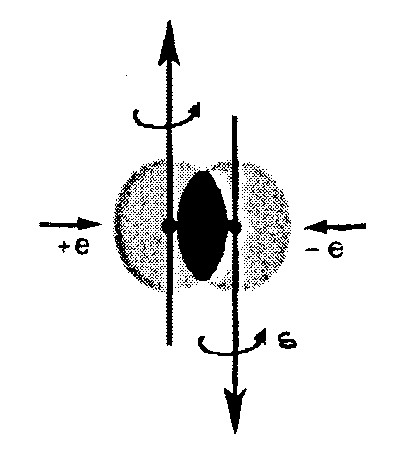
The conceptual foundations of hadronic mechanics: the mutual penetration of the charge distributions and/or wavepackets of particles and related emergence of new interactions of contact type over the volume of mutual overlapping, thus being nonlocal-integral and non derivable from a potential or a Hamiltonian. Note that the very conception, let alone the representation of these new interactions is impossible for quantum mechanics for numerous reasons, such as: quantum mechanics can only represent particles as dimensionless point, for which no overlapping is evidently possible; quantum mechanics has a local-differential structure prohibiting any consistent treatment of the nonlocal integral interactions here considered; quantum mechanics can only represent interactions derivable from a potential, while contact interactions of the type here considered can be represented with anything except a potential or a Hamiltonian; etc. It should be indicated that the study of the new interactions here considered has allowed momentous advances, not only the Rutherford-Santilli neutron considered in this article, but also the first known numerical, exact and invariant representation of valence bonds in molecular structures, and other basic advances in all quantitative sciences [21-25].
Diag. (n112, n222, n132)
Diag. (n212, n122, n232) x
x exp[F(t, r, p, E, d, |>, ...)∫ <2||1>dr3,
U(E |qm>)U+ = E'* T |hm> = E' |hm>,
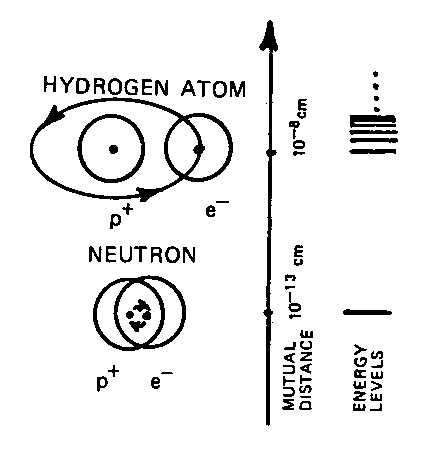
The sole bound state of a proton and an electron predicted by quantum mechanics is the hydrogen atom, with smallest orbit of the order of 10-8 cm. Santilli hadronic mechanics has identified the existence of an additional bound state when the electron orbits within the proton structure at distances of the order of 10-13 cm or less. Remarkably, Santilli has proved that the hadronic state is one and one only, the neutron [24,35], because, when excited, the electron leaves the proton structure, thus recovering all conventional quantum states. In this sense, the energy levels of the hydrogen atom are the excited states of the neutron. As we shall see, these notions are at the foundation of the new hadronic energy studied later on.
the starting equations are the conventional Schroedinger equations for the hydrogen atom (where h represents hbar)
The conceptual interpretation of the spin 1/2 of the neutron, first achieved by Santilli in Ref. [35], is quite simple. As indicated earlier, a general law of hadronic mechanics is that only the singlet coupling of spinning particles at mutual distances of the order of their size is stable, while triplet couplings are highly unstable. Hence, the spin of the proton Sp is equal but opposite to the electron spin Se.
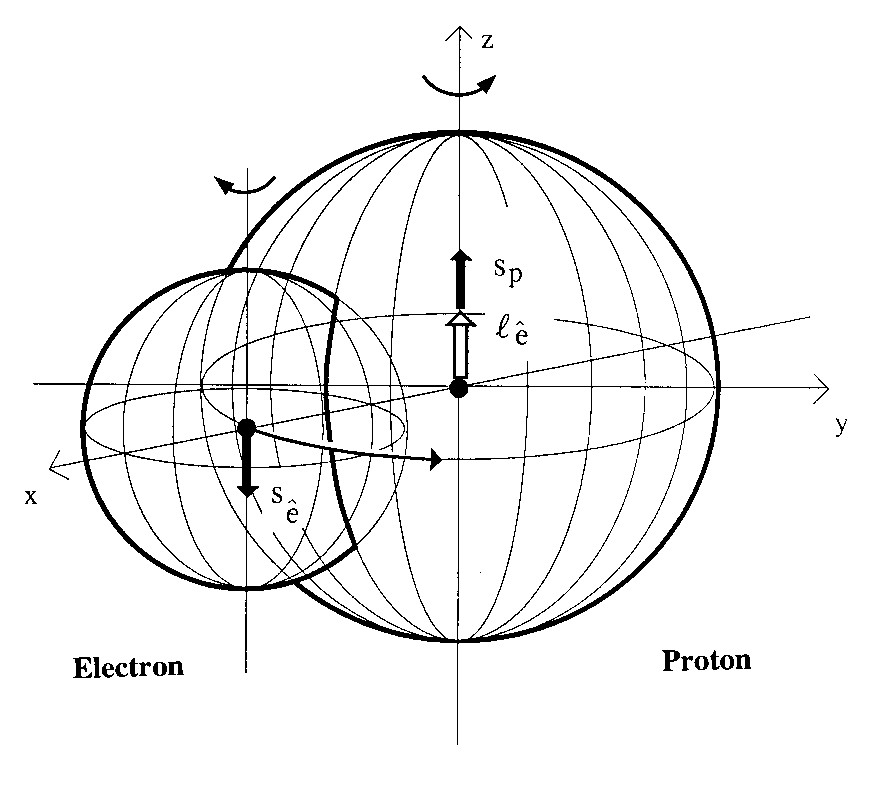
Under the geometry of Rutherford's compression, it is then evident that the isoelectron is constrained to have an orbital angular momentum Me = 1/2, the total angular momentum of the isoelectron is null and the spin of the neutron Sn coincides with that of the proton Sp.
It should be stressed that the above interpretation of the neutron spin is prohibited by quantum mechanics because quantum angular momenta can only have integer eigenvalues. This is due to the fact that, half-odd-integer angular momenta imply the breakdown of the unitarity of the theory, with consequential host of problems, including the loss of causality and probability laws.
However, hadronic mechanics readily allows not only fractional, but even variable angular momenta. since the new mechanics has to represent the angular momentum of an electron in the core of a star, that, evidently, cannot be constant and must change continuously to avoid perpetual-motion-type of academic manipulations in support of preferred theories. Regrettably, for the technical verification of these arbitrary hadronic angular momenta, we have to refer the interested reader to the original literature [24,35].
At this point, the quoted references provide a rigorous proof of Eq. (73) via the Lie-Santilli SU(2)-spin isosymmetry that we cannot possibly repeat here for brevity.
In conclusion, once the point-like abstractions of quantum mechanics are abandoned, and the proton is indeed admitted as an extended particle with a hyperdense medium ion its interior, Santilli has established that the representation of the spin of the neutron in Rutherford's compression inside a star is elementary.
The deviations of these studies from organized academic interests in preferred theories are, however, dramatic. In fact, Santilli's representation of the spin of the neutron does not require any neutrino at all. The reader can now begin to understand the extreme obstruction by academia against Santilli's studies [26,27].
The root of the academic problems remains always the same, the application of quantum laws under conditions in which they are not applicable. The Galilei and Poincare' symmetries characterize the conservation of the celebrated ten conservation laws of total quantities, among which we have the conservation of the total angular momentum.
But, as stressed earlier, the Galilei and Poincare' symmetries are solely applicable for Keplerian systems, namely, for systems of particles at large mutual distance admitting a Keplerian nucleus. But the Rutherford-Santilli neutron has no nucleus. Hence, the application of orthodox Keplerian symmetries to non-Keplerian systems is nonsense at best, or an academic manipulation of science.
The sole symmetries that have been rigorously proved to be valid for the neutron synthesis inside a star are the Galilei-santilli isosymmetry for the nonrelativistic treatment and the Poincare' Santilli isosymmetry for the relativistic case. Reader believing in the existence of other symmetries that are equally applicable on equally grounds, are encouraged to provide the evidence with formulae, rather than pep talks.
It should be indicated that, again, when anti-scientific academic interests are cut out, the above spin anomaly emerges as being deeply linked to the energy anomaly studies above and the magnetic moment anomaly studied below. All these anomalies, if treated without academic politics, may stimulate advances beyond our imagination at this time, such as the possible continuous creation of matter in the universe precisely via the synthesis of the Rutherford-Santilli neutron inside a star, as indicated below.
Representation of the neutron magnetic moment,
Recall that quantum mechanics cannot possibly represent the magnetic moment of the neutron
from the known magnetic moments of the proton and the electron,
By comparison, the exact numerical representation achieved by Santilli for the first time in Ref. [35] is of an astonishing simplicity, with the understanding that its technical treatment requires serious study.
In essence, quantum mechanics failed to represent μn because the proton and the electron can only be represented as points. Additionally, quantum mechanics does not allow the electron to have orbits inside the proton because these conditions cannot be even formulated, let alone treated, with quantum mechanics.
Once the proton is admitted what it is in the physical reality, an extended object with a hyperdense medium in its interior, and one admits the constraint under which the isoelectron is forced to orbit in its interior following Rutherford's compression, one can see that *quantum mechanics misses a third and crucial contribution for the magnetic moment of the neutron, the magnetic moment created by the orbital motion of the electron inside the proton. The latter has been calculated by Santilli resulting in the value
thus achieving the following numerically exact and invariant representation of the neutron magnetic moment
where the orientations of the spin and related magnetic moments of the preceding figure should be kept in mind.
It should be stressed that, authoritative callings of Santilli as one of the most important scientists in history are no jokes. They are based not only on Santilli's achievements in mathematics, physics and chemistry, but also on the depth of the achievements themselves.
In fact, the rigorous proof of the representation of the magnetic moment of the neutron required Santilli to construct isomathematics with particular references to the isodifferential calculus, the Minkowski-Santilli isogeometry, and the isotopies of conventional spacetime symmetries, all the way to the isotopies of the spinorial covering of the Poincare' symmetry.
After this preparatory work, Santilli constructed the isotopies of the Dirac equation that provided the most rigorous verification of the magnetic moment of the neutron as outlined above.
Needless to say, we cannot possibly review all these advances and have to refer serious readers to the quoted literature. Scientific criticisms are always constructive, thus being an important part of the scientific process. However, to be ³scientific,² criticisms have to be technical, thus based on indepth knowledge of the field.
Thus, a technical knowledge (rather than the usual glancing) of Santilli¹s works will be requested by colleagues throwing criticisms, to prevent denounciations of clear anti-scientific conduct.
27. Continuous creation of matter in the neutron synthesis and new longitudinal communications in space?
At the 2006 meeting of the International Association of Relativistic Dynamics (IARD) held at the University of Connecticut in Storrs, Santilli [38] presented his views on the neutron synthesis that can be summarized as follows.
In Santilli's view,the original Pauli-Fermi hypothesis (1), that is,
is incompatible with the synthesis of the neutron inside stars because:
1) The proton and the electron are the only permanently stable massive particles known to mankind that, as such, simply cannot "disappear" at the time of the synthesis and, consequently, they must be actual physical constituents of the neutron.
2) Once the preceding physical reality is admitted, the hypothesis of the emission of a neutrino as per reaction (79) has no scientific foundation because the proton and/or the electron cannot "decompose" themselves to produce a hypothetical spin 1/2 particle.
3) The synthesis of the neutron is outside quantum mechanics because, on one side, all quantum mechanical syntheses (such as those for nuclei, atoms and molecules) "release" energy, while the synthesis of the neutron "requires" energy.
Hence, Santilli points out that, by its very conception, reaction (79) prevents any quantitative, treatment of the neutron synthesis, since all quantum equations become inconsistent under the conditions of reaction (79), namely, when the total rest energy of the r.h.s. is greater than that of the l.h.s.
Santilli then pointed out that the complementary reaction (6), that is,
is even more incompatible with the neutron synthesis than reaction (79) because:
4) There is no credible source of antineutrinos inside a stars in the enormous number needed to allow up to 10100 neutron syntheses per second.
5) The cross section of antineutrinos with electrons and/or protons is null. Hence, assuming that the antineutrino is somewhat identified by political manipulations, and assuming that it is manipulated to carry the missing energy of 0.78 MeV, that energy will never ever be transmitted to the proton and/or to the electron for the neutron synthesis.
6) The physics of the 20-th century suffered of a huge scientific imbalance caused by the fact that matter was treated at all levels, from Newton to second quantization, while antimatter was treated solely at the level of second quantization. Another historical contribution by Santilli, not treated in this page, has been the resolution of this imbalance and the presentation of a new theory of antimatter [19] allowing full scientific democracy with matter, that is, antimatter can be treated via Santilli theory at all levels, from Newton to Second quantization, exactly as it is the case for matter. The necessary condition for this scientific democracy is that all antiparticles have a negative energy although referred to a negative unit, Santilli isodual unit [19]. Consequently, the presence of the antineutrino in reaction (80) requires, rather than releases, energy.
In view of all the above inconsistencies, Santilli dismissed altogether in paper [38] the hypothesis of the emission of a neutrino in the neutron "synthesis," although left the issue of the possible emission of the antineutrino in the neutron "decay" to separate studies.
This evidence lead to the presentation of Santilli's neutron synthesis via hadronic mechanics summarized in the preceding sections in which is no need whatsoever of the neutrino hypothesis.
In the same historical paper [38], Santilli then addressed the issue: where are the missing energy, spin and magnetic moment in the neutron synthesis coming from? To initiate quantitative studies of this so fundamental an open problem, Santilli introduced the following:
SANTILLI AETHERINO HYPOTHESIS [38]: The energy, spin and magnetic moment missing in the synthesis of neutrons from protons and electrons originate from either the environment inside a star or from the aether conceived as a universal medium of very high energy density, via an entity called "aetherino" and denoted with the letter "a"according to the reaction
Note the dramatic difference between reaction (79) and (81). In fact, the former "releases" a particle in the r.h.s., thus rendering structural equations even more inconsistent, while the latter provides the missing quantity in the l.h.s. for consistent treatment.
Next, Santilli stressed emphatically that the aetherino "is not" a particle, but a symbol merely representing the transfer of the quantities missing in the neutron synthesis. In fact, the aetherino should be a particle if the neutron synthesis is treated with quantum mechanics. However, in this case the neutron should be a three-body bound state of a proton, an electron and the aetherino, which is nonsense.
It is at this moment that Santilli hadronic mechanics enters into science with all its historical dimensions. When the synthesis is treated via hadronic mechanics, the neutron synthesis according to reaction (81) remains a purely two-body" bound state.
More specifically, a technical understanding of hadronic mechanics is reached when one understands that the transition from a conventional Hilbert space to the covering Hilbert-Santilli isospace is a direct representation of the missing quantities in the neutron synthesis.
Hence, a major scientific role of hadronic mechanics is preventing the addition of another hypothetical particle to the current particle zoo, since the latter is already too much full of academic games.
In the historical paper [38], Santilli did not assume a position as to whether the aetherino represents the transfer of quantities from the physical environment inside a star or from the aether. However, he pointed out that there are doubts as to whether the missing quantities originate from the physical environment.
In fact, stars are the most majestic source of energy in the universe. If the missing energy in the neutron synthesis originates from the environment inside a star, stars should lose something of the order of 10100 MeV per second. This is not a scientifically plausible view because stars initiate the emission of energy immediately following their condensation of the original hydrogen composition, and definitely do not lose energy.
Additionally, Santilli noted that there are other events in astrophysics that simply cannot be numerically explained via quantum mechanics and the neutrino hypothesis. One of them is the supernova explosion, in which stars release such a large amount of energy, to be visible by the naked eye from distant galaxies. But, at the time of the supernova explosion, stars have mostly exhausted their nuclear syntheses. Hence, the idea that the enormous energy needed for a supernova explosion originates from the residual ordinary nuclear synthesis has no scientific credibility because it does not permit a quantitative representation (verbose interpretations by academia for political interest are a different matter).
In view of the above and other very intriguing open issues, Santilli indicated in paper [38] that the old hypothesis of continuous creation of matter in the universe is indeed plausible and does indeed deserve serious studies, because continuous creation could be realized via the synthesis of the neutron inside stars.
According to this view, space is a universal substratum for all events visible to man and has a very high energy density. The synthesis of the neutron could then be a mechanism precisely for the transfer of energy, spin and magnetic moment from space to the neutron, thus resulting in creation of energy in our visible universe, but always in such a way that energy in the universe inclusive of the aether is conserved.
Finally, Santilli addressed in historical paper [38] the issue of the neutron decay and he suggested the study of the two alternatives:
Paper [38] stressed that the conventional alternative (82) cannot be excluded on grounds of current knowledge, hence the title of the paper "The etherino and/or neutrino hypothesis." However, he stressed that the alternative hypothesis (83) is equally plausible and should be investigated.
Paper [38] additionally stressed that alternative (83) can stimulate new scientific renaissance with advances beyond our imagination at this time. In fact, alternative (83) essentially represents the return to the aether of the originally missing quantity.
Consequently, the release of the missing quantities from the aether to the neutron and/or the return of the same quantities to the aether in the neutron decay constitute a potential new form of communication that, for technical reason, can only be longitudinal, that is, with oscillations in the direction of propagation.
In Santilli's own words [38]: When seen at the interstellar level, the current communications via electromagnetic waves are the same as the communications via smoke signals during prehistoric times. In fact, despite their speed, electromagnetic waves are extremely slow for interstellar communications.
But electromagnetic waves are transversal, namely, the oscillations of the aether are perpendicular to the direction of propagation. By comparison, Santilli aetherino can only propagate longitudinally for technical reasons we cannot review here (see volume [24]), in which case its speed is expected to be several millions times bigger than the speed of light, thus having a possible practical value for interstellar communications,
As a final point, Santilli indicates in historical paper [38] that, even though he excludes the release of a neutrino in the neutron synthesis for the technical reasons indicated above, nevertheless the current experiments on neutrino detection could be correct, and actually be the first potential evidence for a basically new form of longitudinal communication.
In fact, neutrinos cannot be directly detected as stressed by Enrico Fermi. hence, current "neutrino detections' in reality detect events predicted by the neutrino conjecture. But then exactly the same experimental data can be interpreted via the aetherino conjecture.
To illustrate one of the reasons for the criticism of academia in this presentation, the reader should know that, immediately following the appearance of paper [38], the Editor in Chief of the journal of its publication, Foundations of Physics, was terminated by organized academic interests and replaced with a notorious supporter of orthodox theories, Gerard ¹t Hooft.
This replacement occurred following pressures at the publisher (Springer) by academic interests, and it is meant to prevent additional publications at Foundations of Physics of innovative papers. Whether this is true or false, is an irrelevant issue. By comparing the scientific reputations of van der Merwe and of ¹t Hooft, no physicist with a minimum of dignity can deny that the replacement of the former with the latter as Editor in Chief of FP is a major blow to scientific democracy.
The irony is that academia still dreams of maintaining the old control of scientific thought via publications, which dream is outside realities these days due to the equalizing internet. Besides, academia has lost credibility for basic advances as evident throughout this presentation.
It is rewarding to report that, because of his lifetime dedication to scientific democracy for qualified inquiries, Professor Melvin van der Merwe was awarded the 2007 Gold Medal for Scientific merit by the Santilli-Galilei Association (see http://www.santilli-galilei.com)
We would like to take this opportunity to express deepest appreciation to: all members of the International Association of Relativistic Dynamics (mostly from Israel) for the scientific democracy of their meetings as illustrated by Prof. Santill's presentation ['38] at their 2006 meeting; the four expert reviewers selected for the publication of paper [38]; and Prof. van der Merwe because he will be remembered as one of the most important scientific editors of the 20-th century, while the memory of other editors will fade aware into academic politics.
28. Don Borghi experiment on the synthesis of neutrons from protons and electrons
The first experiment on the synthesis of neutrons from protons and electrons was according to Rutherford conducted by Carlo Borghi and his associates C. Giori and A. Dall'Olio in the 1960s at the CEN Laboratories in Recife, Brazil [39,40].The experiment is today known as Don Borghi experiment from the name of the team leader, an Italian priest-physicist from the University of Milan.
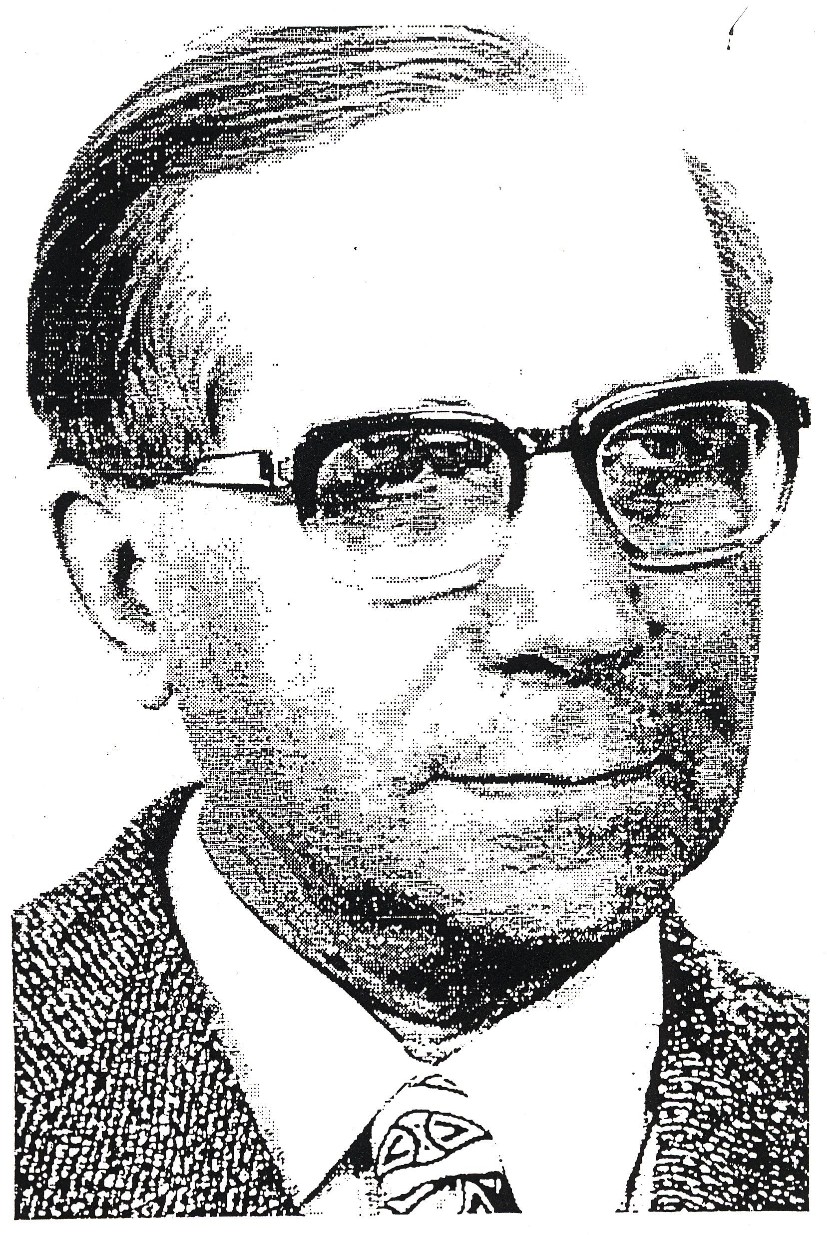
In essence (see Vol. IV, Section 6.2 for details, analyses and historical accounts such as that by L. Daddi), the experimentalists placed in the interior of a cylindrical metal chamber (called klystron) a hydrogen gas (at a fraction of 1 bar pressure originated from the electrolytical separation of water, and kept mostly ionized by an electric arc with about 500 V and 10 mA. Additionally, the gas was traversed by microwaves with 10-10 s frequency. Since protons and electrons are charged, they could not escape from the metal chamber, and remained trapped in its interior.
In the cylindrical exterior of the chamber the experimentalists placed various materials suitable to be activated when exposed to a neutron flux (such as gold, silver and other substances). Following exposures of the order of days or weeks, the experimentalists reported nuclear transmutations due to a claimed neutron count of up to 104 cps, apparently confirmed by β emissions evidently not present in the original material.
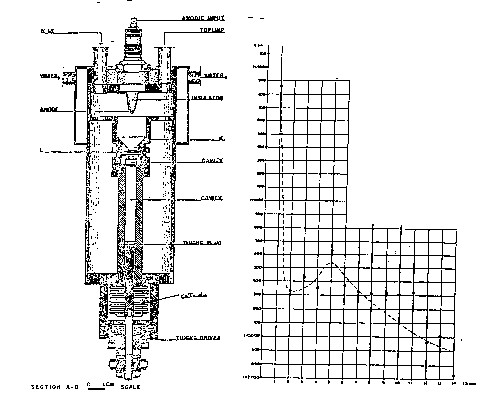
Note that experiment [39,40] makes no claim of direct detection of neutrons, and only claims the detection of clear nuclear transmutations. Note also the dual presence of the electric arc plus the microwave. Note finally the credibility of the source, two of the experimentalists (Don carlo Borghi and Don Camillo Giori) being Catholic priests.
Needless to say, Don Borghi experiment is in need of independent reruns, either in its original form, or in one of several alternatives discussed in the next section. Nevertheless, Don Borghi experiment constitutes the first historical test on Rutherford's conception of the neutron, and it is remarkable, not only because of the claimed results, but also because of its simplicity and low cost, yet fundamental scientific implications.
Reader should be aware that, due to the irreconcilability of the results with quantum mechanics, tests [39,40] have been the victim of incredible acts of scientific misconduct aimed at their discredit while carefully avoiding their rerun. As Prof. Santilli's puts it: "The dismissal of Don Borghi's experiment with the sole use of theoretical theologies and without actual counter-measurements, is a clear scientific crime due to the intended or implied damage to basic scientific and environmental aspects."
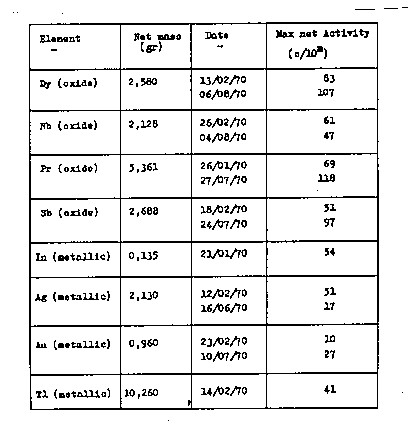
29. Santilli experiment on the synthesis of neutrons from protons and electrons
Having dedicated his research life to the synthesis and structure of the neutron, Prof. Santilli proposed for over thirty years the repetition of Don Borghi experiment to a large number of laboratories and institutions the world over with no avail. The list of rejections is rather incredible, and includes large and small laboratories and universities in the USA, Europe, Russia and China (see Volume [24] for details).
All academic structures contacted by Prof. Santilli preferred the conduction of immensely more expensive and dramatically less relevant experiments over the repetition of Don Borghi's experiment for the obvious, or otherwise only plausible reasons that the latter is known to be irreconcilably incompatible with Einstein theories and quantum mechanics.

Particularly unreassuring are the rejections to proposals with full academic credentials, such as when filed by Prof. Santilli when a member of Harvard University under DOE support, as well as following professional documentation of the scientific and environmental implications [26,27]. We are here referring to a documentation establishing that the loyalty of organized academic interests to Einstein theories and quantum mechanics was superior to any other scientific and.or human value.
In view of this deplorable condition of academia at this writing (mid February 2008), to the limit of clearly assuming anti-scientific and anti-social overtones, Prof. Santilli had no other choice than that of repeating Don Borghi experiment himself at the laboratory of the Institute for Basic Research in Palm Harbor, Florida, with the assistance of his technicians Terry Allen, Tom Judy, Michael Rodriguez, Gene West, Jim Alban and Ray Jones.
The experiment was initiated in spring 2006 and concluded in early 2007 following all possible verifications and controls. The results were originally reported in paper [41] of 2007, with a comprehensive presentation in Volume [24] of 2008 here adopted almost verbatim, and with copies of the numerous scans, print outs, and reports available in the web site [42].
Santilli conceived his experiment [41] as being solely based on the use of an electric arc within a cold (i.e., at atmospheric temperature) hydrogen gas without any use of microwave at all. This was selected for the specific purpose of initiating systematic studies on the mechanism creating the neutral entities first detected by Don Borghi. The expectation was that, in the absence of any detection of neutral entities via the sole use of the electric arc, the addition of high frequency microwaves was expected to be necessary.
Santilli conducted the radiation counts via:
1) A detector model PM1703GN manufactured by Polimaster, Inc., with sonic and vibration alarms as well as memory for printouts, with the photon channel activated by CsI and the neutron channel activated by LiI. For reasons still under investigation (see below), the Li-activated neutron detectors resulted to be the most active and its use is necessary for any serious repetition of Santilli's tests.
2) A photon-neutron detector SAM 935 manufactured by Berkeley Nucleonics, Inc., with the photon channel activated by NaI and the neutron channel activated by He-3 also equipped with sonic alarm and memory for printouts of all counts. This detector was used to verify the counts from the preceding one.
3) A BF3 activated neutron detector model 12-4 manufactured by Ludlum Measurements, Inc., without counts memory for printouts. This detector was used to verify the counts by the preceding two detectors.
Electric arcs were powered by welders manufactured by Miller Electric, Inc., including a Syncrowave 300, a Dynasty 200, and a Dynasty 700 capable of delivering an arc in DC or AC mode, the latter having frequencies variable from 20 to 400 Hz. As shown below, the use of an ordinary DC welder is necessary for any serious repetition of the test.
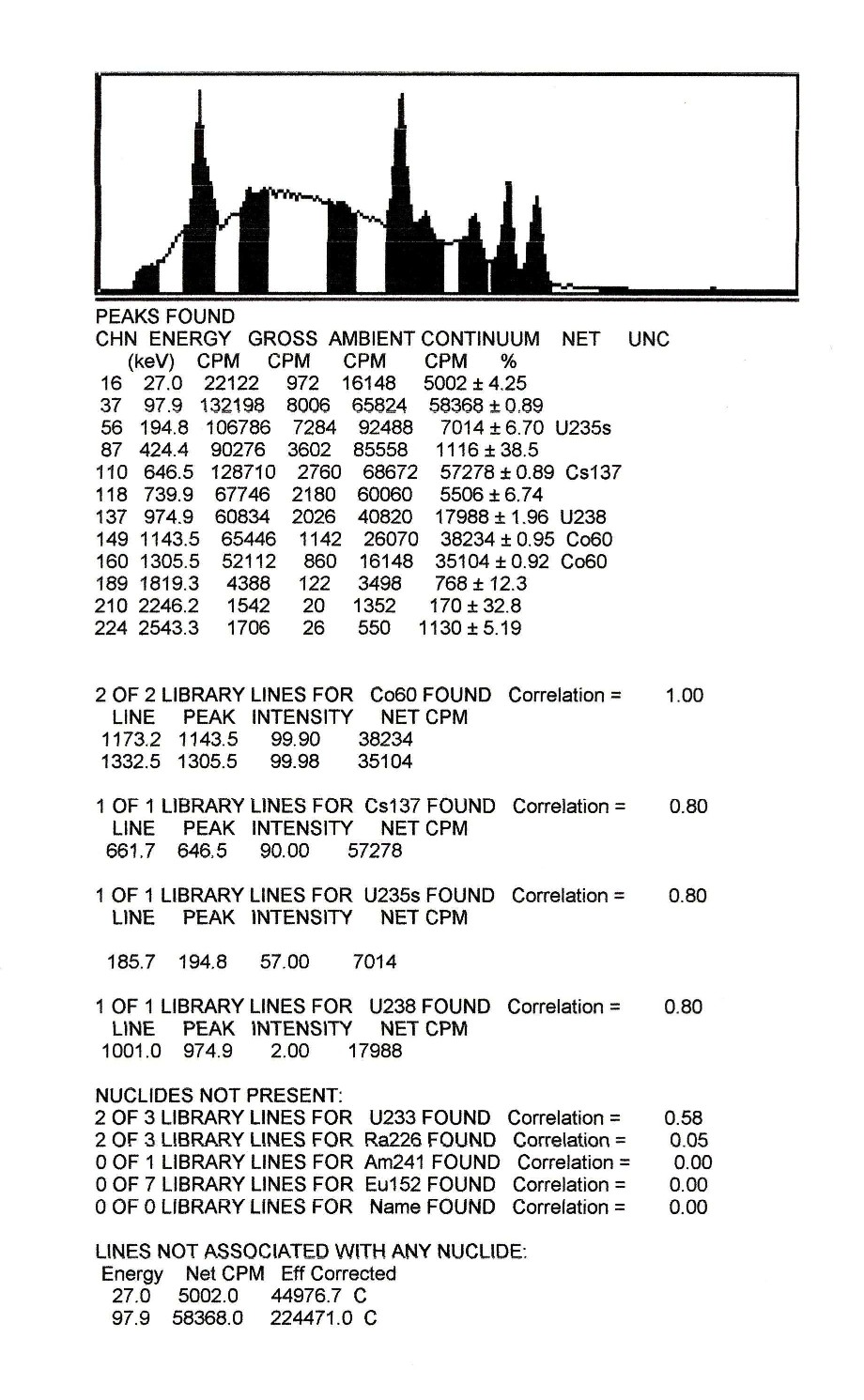
The following three different klystrons were manufactured, tested and used for the measurements (see [42] for pictures):
Klystron I: A sealed cylindrical klystron of about 6" outside diameter (OD) and 12" height made of commercially available, transparent, PolyVinyl Chloride (PVC) housing along its symmetry axis a pair of tungsten electrodes of 0.250" OD and 1" length fastened to the tip of 0.250" OD copper rods protruding through seals out of the top and bottom of the klystron for electrical connections. The electrodes gap was controllable by sliding the top conducting rod through the seal of the flange.
The klystron cylindrical wall was selected to be transparent so as to allow a visual detection of the arc because, as shown below, in the absence of a true DC arc within a pure hydrogen gas, no detection is possible.
Following initiation of a real DC arc within the hydrogen filled klystron, there were hours and at times days of no detection at all by all counters. However, hours after shaking the klystron, detections occurred in a systematic and repetitive way.
The detection were triggered by a neutron-type particle, excluding contributions from photons (because often their count were null as shown by the scans), and they were definitely not due to vibrations. However, these detections were anomalous, that is, they did not appear to be due to a flux of actual neutrons originating from the klystron.
This anomaly is established by the repeated "delayed detections," that is, exposure of the detector to the klystron with no counts of any type, moving the detector away from the klystron (at times for miles), then seeing the detectors enter into off-scale vibrational and sonic alarms with zero photon counts.
The first case of this type occurred when Prof. Santilli exposed detector PM1703GN to the klystron following the arc, put the detector in his briefcase and went to a local Walgreen store for purchases, which store is located some 15 m driving distance from the lab. To Prof. Santilli's great surprise and embarrassment, the detector in his briefcase entered into a maximal off-scale, sonic and vibrational, neutron alarm while he was in line for the payment of his bill. He had to leave his purchases and rush out of the store while the store personnel was calling security for control.
The 15 m "delayed self-activation" was reproducible with detector PM1703GN with the same time delay but in different locations although not with the other two who showed a different type of anomalous count (see [24] for brevity), thus establishing a dependence of the neutron counts from the type of activation as well as on the casing material of the detector itself.
Klystron II: A rectangular, transparent, PVC klystron 3" x 3" x 6" filled up with commercial grade hydrogen at atmospheric pressure and temperature traversed by a 2" long electric arc powered by a standard Whimshurst electrostatic generator.
This klystron was conceived for an implosion caused by combustion with atmospheric oxygen, thus explaining the small size of the klystron. This test was conducted only once because of instantaneous off-scale detection of neutrons by all detectors such to cause evacuation of the laboratory. Hence, this test was not repeated for safety.
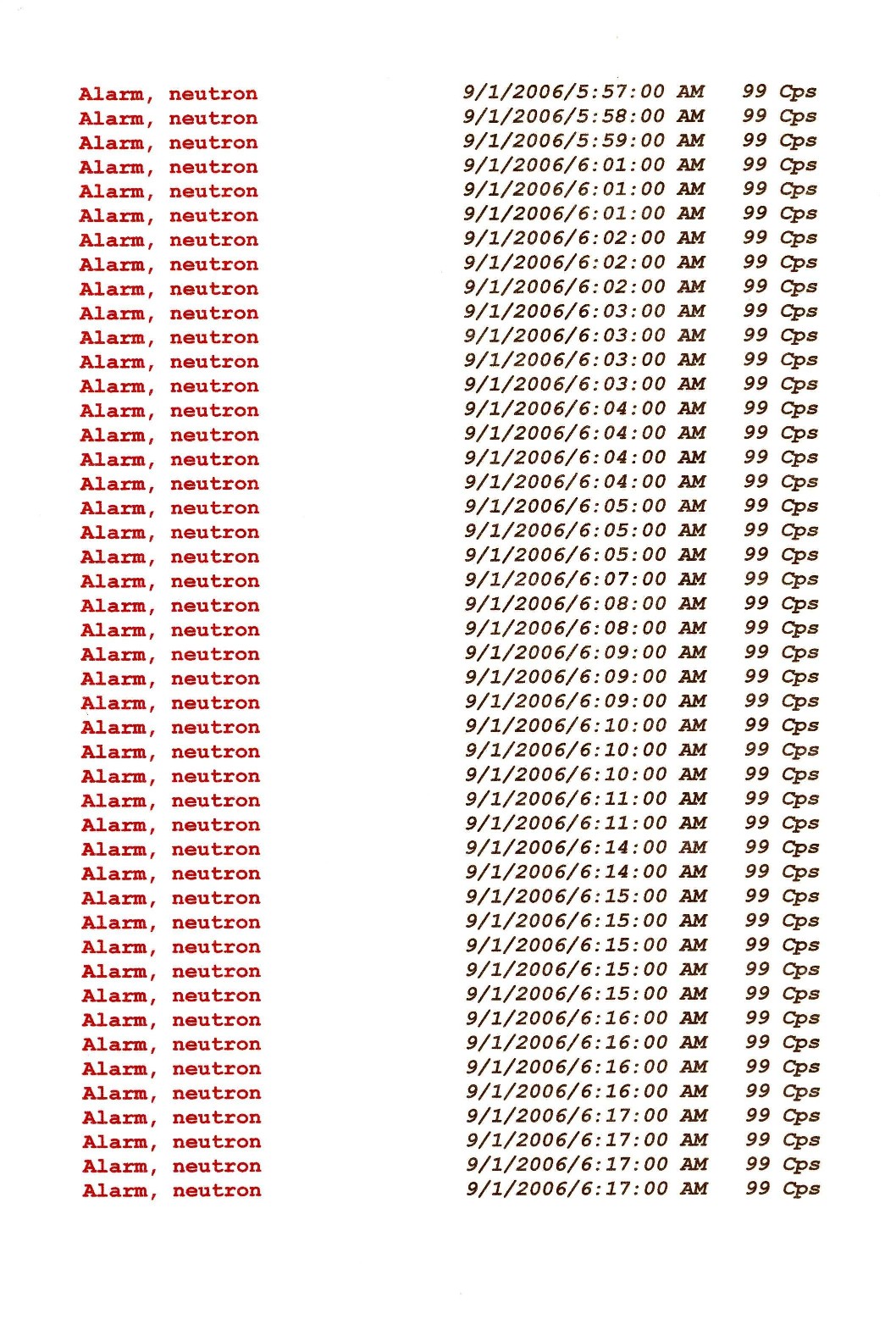
Klystron III: A cylindrical metal klystron fabricated in schedule 80 carbon steel pipe with 12" OD, 0.5" wall thickness, 24" length and 3" thick end flanges capable of withstanding hydrogen pressure up to 500 psi with the internal arc between thoriated tungsten electrodes controlled by outside mechanisms.
This test was conceived for the conduction of the test at bigger hydrogen pressure compared to that of Klystron I. The test was conducted only once at 300 psi hydrogen pressure because of instantaneous, off-scale, neutron detections such to cause another evacuation of the laboratory.
It should be stressed that Santilli had no intention or interest in measuring the cps, since that would have been premature and, in any case, require much more sophisticated equipment. Hence, the main purpose of Santilli's tests was to establish the production of neutron-type particles via a DC arc within a hydrogen gas.
No meaningful counts were detected with the above identified klystrons in using various gases other than hydrogen, although this should not exclude possible similar effects under sufficiently more powerful arcs. No neutron, photon or other radiation was measured from electric arcs submerged within liquids. Hence, the data herein reported appear to be specific for electric arcs within a hydrogen gas under the indicated conditions.
At the end of the tests, all detectors were returned to their manufacturers for control, and all detectors were certified as operating properly. The manufacturers then as released the scans accumulated in the detector memories, some of which are reproduced in web site [42].
In summary, Santilli [24,41,42] states that an electric arc within a hydrogen gas at a few psi pressure and atmospheric temperature as above described for Klystron I produces "entities" that:
1) Are not hydrogen atoms (because in that case no nuclear transmutation would be conceivably possible);
2) Have dimensions of the order of 1 ~fm as for all hadrons (otherwise the detectors would show no counts);
3) Are neutral (otherwise they would not move through walls);
4) Are stable for hadron standards (more accurate data being grossly premature at this writing);
5) Remain initially confined within the arc chamber under steady conditions, to slowly exit, except for the case of production under implosion causing rapid propagation;
6) Are generally released hours following the tests, with anomalous counts lasting for weeks;
7) Are not neutrons due to the anomalous behavior of the detectors.
However, Santilli does not exclude that the "entities" produced in the tests with Klystrons II and III are indeed actual neutrons, due to the instantaneous as well as off-scale nature of the neutron alarms in clear absence of photon or vibrations.
Whatever their interpretation, we can state that Santilli's experiment [24,41,42] confirms Don Borghi's experiment [39,40] because the latter test detected nuclear transmutations on various substances placed in the vicinity of the klystrons, which transmutations are the main results of former tests. Different views are political since they would require a the impossible proof that the nuclear transmutations of tests [41,42] are incompatible with those of tests [39,40].
30. The Don Borghi-Santilli neutroids
Santilli [24,41,42] excludes that the entities produced in the tests with Klystron I are true neutrons for various reasons, such as:
1) The anomalous behavior of the detector. In fact, their behavior, as in the case of the 15 m delay, self-activated detection indicates first the absorption of "entities" producing nuclear transmutations that, in turn release ordinary neutrons.
2) The environment inside stars can indeed produce the missing energy of 0.78 MeV for the neutron synthesis, but the environment inside Klystron I cannot do the same due to the very low density of the hydrogen gas. The assumption that the missing energy is provided by relative kinetic energy must be excluded for numerous reasons, including the geometry of the arc illustrated in the figure, let alone the impossibility of the synthesis itself at the indicated relative energy. Hence, the belief that the tests with Klystron I produced actual neutrons directly implies the acceptance of the continuous creation as indicated above.
3) The physical laws of hadronic mechanics do not allow the synthesis of the neutron under the conditions of Klystron I because of the need of the trigger, namely, an external event permitting the transition from quantum to hadronic conditions. In fact, the tests with Klystrons II and III do admit the trigger required by hadronic mechanics and that could bea reason for their violent alarms.
In view of various reasons, Don Borghi et al [39,40] submitted the hypothesis that the "entities" are neutron-type particles called neutroids. Santilli adopted this hypothesis and presented the first technical characterization of neutroids with the symbol ñ and the characteristics in conventional; nuclear units A = 1, Z = 0, J = 0, amu = 0.008. Hence, Santilli assumed that in Klystron I he produced the following reaction precisely along Rutherford's original conception
where: the value J = 0 is used for the primary purpose of avoiding the spin anomaly in the neutron synthesis as indicated above; the rest energy of the neutroids is assumed as being that of the hydrogen atom because in atomic mass units 1 amu = 931.49 MeV, mp = 938.27 MeV = 1.0078 amu and me = 0.511 MeV = 0.0005 amu, for which the hydrogen mass is given approximately by 0.008 amu; the p-e binding energy of Coulomb nature is too small for the approximation considered, being of the order of 10-3 MeV.
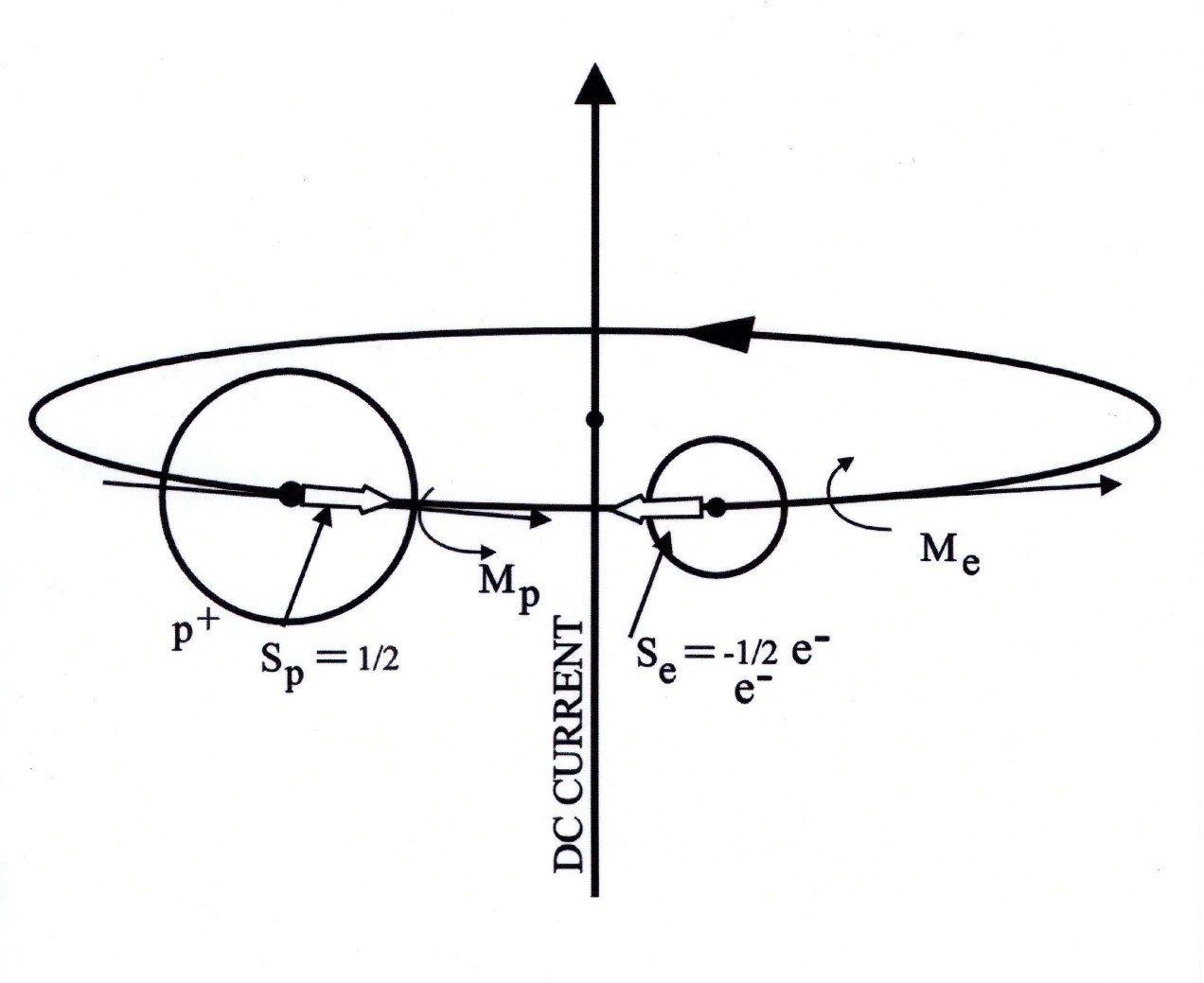
the interpretation submitted by Santilli is that the geometry of the electric arc is quite conducive to processes causing the synthesis of neutron-type particles. By recalling that the magnetic field created by an electric arc is directly proportional to the current and inversely proportional to the distance, in the conditions of tests [41], protons and electrons are exposed to magnetic field with an intensity of the order of 108 G when at atomic distances from the arc.
Under so powerful a magnetic field, the geometry of the electric arc first aligns protons and electrons with their magnetic moments along the tangent to the local magnetic force. Subsequently, the same geometry is predicted to cause protons and electrons to collapse into a neutral, hadron-size particle due to the very strong Coulomb attractions at short distances of both, opposite charges and opposite magnetic polarities (see the figure).
The creation of neutroids is then due to additional reasons, such as the tendency of DC electric arc of compressing magnetically polarized particles toward the arc itself, resulting in the creation of the neutron-type neutroids.
The reason should be aware that, despite the absence of the energy, spin and magnetic anomalies, neutroids are strictly and irreconcilably incompatible with quantum mechanics, and solely treatable via the covering hadronic mechanics. In fact, the sole bound state predicted by quantum mechanics is that for which it was built for, the hydrogen atom.
31. Interpretation of Don Borghi and Santilli experiments
Don Borghi experiment has been strongly criticized by academia, particularly by editors of major physical societies, on pure theoretical grounds without the actual repetition of the tests, thus violating basic rules of scientific ethics (see the denounciations in Volume [24]).
Hence, Prof. Santilli states quite candidly [24]: The claim on pure theoretical grounds without reruns that the experimentalists of tests [39,40], two of them being Catholic priests, have lied in their claims is so ludricous that can only be proffered by immoral outcasts.
Hence, Santilli assumes that the main claim of papers [39,49] is true, namely, that the various substances placed in the exterior of the klystron did indeed experience nuclear transmutations. By recalling the impossibility for Don Borghi's klystron and Santilli's Klystron I to produce actual neutrons, the main open issue is where the neutrons originating activation and detection come from.

Evidently, only two possibilities remain, namely, that the detected neutrons were actually synthesized in the walls of the klystrons, or by the activated substances themselves following the absorption of the neutroids produced by the klystrons.
By remembering that the neutrino hypothesis has no sense for the neutron synthesis for so many independent reasons reviewed above, Santilli assumes that the energy, spin and magnetic anomalies in the neutron synthesis are accounted for by their transfer either from nuclei or from the aether via his etherino hypothesis
In other words, once neutroids are absorbed nu nuclei, ordinary neutrons can be produced via a variety of mechanics, the first one being the supply of the missing energy, spin and magnetic moment by the nucleus itself, the second one being the origination from the aether.
To avoid the joint treatment of excessively complex conditions and event, Santilli ignored the identification of the origination of the anomalies and deferred it to serious experimentalists, that is, experimentalists interested in truly basic open issues, rather than peripheral issues of essentially academic relevance.
Then, Refs.[24,41,42] shows that assumption (85) is sufficient, alone, to represent ''all" Don Borghi's data [39,40]. The open issue is whether the neutron synthesis occurs directly in the nuclei of the activated substances or in the walls of the klystron.
To study this alternative, Santilli assumes the usual symbol N(A, Z, J, u) for ordinary nuclides as currently known, and the symbol Ñ(A, Z, J, amu) for possible anomalous nuclides, namely, nuclides following the absorption of a nuclidoid not existing in available data, called nuclidoids.
Santilli also assume that the binding energy of a neutroid is similar to that of an ordinary nucleon (e.g., BE = 0.0002 amu for the deuteron), since neutroids are assumed to be converted into neutrons when inside nuclei, or to decompose into protons and electrons, thus recovering again the nucleon binding energy.
In this way, Santilli indicates the following possible nuclear reaction for one of the activated substances in Don Borghi's tests
thus recovering conventional activation processes.
By comparison, the application of the above assumption to the steel casing of Don Borghi klystron yields an unknown nuclidoidˆ
since the tabulated nuclide is Fe(58, 26, 0, 57.933).
Needless to say, the anomalous nuclide &Ftilde;e(58, 26, 1, 57.941) is expected to be highly unstable and to decay in a variety of possible modes, although they do not appear to provide the source of neutrons necessary to represent Don Borghi data.
This excludes that the neutrons in Don Borghi experiment were synthesized in the walls of his klystron and confirms that the neutrons were synthesized by the activating substances themselves.
Hypothesis (85) also allow an interpretation of some of Santilli detections [41,42], with the understanding that the anomalous behavior of the detectors, such as the delayed neutron counts, requires special studies and perhaps the existence of some additional event not clearly manifested in Don Borghi's tests.
To initiate the study, Santilli considers the first possible reaction
namely, we have the prediction that, under transmutation (85), the coupling of a neutroid to a proton creates the ordinary deuteron. As such, neutrons cannot be credibly assumed to originate inside Klystron I.
Next, Santilli considers the polycarbonate of Klystron I wall containing about 75 % carbon, for which we have
thus excluding the carbon of the polycarbonate being a source of the detected neutrons.
Finally, said polycarbonate contains about 18.88 % oxygen for which we have the reaction yielding an unknown nuclidoid
because the known nuclide is O(17, 8, 5/2, 16.999). The latter reaction too is not expected to provide the neutron counts detected by Santilli.
In conclusion, in Santilli's experiment too, it does not appear that the detected neutrons are synthesized in the interior of the Klystron I or by its walls.
The above analysis leaves as the only residual possibility that in Santilli tests, the neutrons are synthesized by the detectors themselves. To study this possibility, Santilli considers the reaction for the He3-activated detector
in which, as one can see, the detection of the neutroids is anomalous if any.
Next, for the base of $-activated detectors we have the reactions
that do not appear to behave normally under a flux of neutroids.
Finally, we have the reaction for the Li-activated detectors
that do indeed behave in a way fully equivalent as to whether the detection refers to neutroids or neutrons.
From the above reactions we can see a conceivable explanation of the reason the He3-activated detector resulted as being the least active of all in tests [41,42]. We can also see a plausible reason for the Li-activated detector as being the bests for Santilli's experiment, and that's the reason for mandating its use for any serious reruns of Santilli's experiment (unless the rerun is commissioned to fake the test, as indicated below).
The conclusion is, therefore, that the neutrons detected in Don Borghi experiment were synthesized by the nuclei of the activated substances, while the neutrons of Santilli experiment were synthesized by the detectors themselves, either by their activating substance, or by their casing, the latter expected to be the origin of the delayed detection.
In closing, Santilli warns readers against superficial conclusions, one way or another, no matter how appealing they are, because of the possibility that neutroids could be produced inside Klystron I in clusters much similar, although different than electron clusters, in which case the absorption of neutroid clusters by ordinary nuclei is much more complex and cannot be treated here (see Volume [24]).
32. How to fake Don Borghi and/or Santilli experiments
Santilli denounces in Volume [24] a rather systematic pattern whereby, as soon as an experiment establishing deviations from Einstein theories and quantum mechanics somehow manages to escape the grip of control by organized academic interests, counter-experiments are soon commissioned to re-established the validity of preferred doctrines.
Ref. [24] has additionally denounces the widespread fact that, while experiments deviating from established theories experience extreme difficulties in being published by journals of known physical societies, papers presenting counterclaims are published with extreme ease despite their very questionable content.
Finally, Santilli has denounced the fact that the "experimental results" of numerous counter-experiments are manipulated in a very transparent way to achieve a pre-set aim. In fact, the elaboration of particle experiments these days is extremely complex, and requires the use of countless assumptions, functions, parameters and so on, thus being extremely simple to adapt their values to verify Einstein theories and quantum mechanics (see the incredible documentation in Appendix 6.A of Volume [24]), all this occurring under full public funding.
In view of this documented, but deplorable condition of contemporary academia, we should expect the commissioning of the disproof of Don Borghi and Santilli experiments. Since academia, in the final analysis, also includes honest physicists, in Vol. [24] Santilli adds a section on the following suggestions on how to fake his experiment, since that knowledge is useful to both honest and dishonest academicians:
1) In Santilli's klystron, the electric discharge can be made under a short with no gap between the electrodes, in which case no "entities" are produced and the occurrence can be used to "disprove Santilli experiment." In fact, for the "entities" to be produced, it is necessary to have a real electric arc within a hydrogen gas with at least 15-20 Kw causing at least a minimal gap of 2-3 mm for at least 4-5 s. When there is a short without gap, the electric current propagates through the electrodes with insignificant impact in the hydrogen gas. Hence, the honest (dishonest) scientist will make sure to have (not to have) a real gap with a real arc within the hydrogen gas to repeat (to "disprove") Santilli's tests.
2) Santilli's experiment can be repeated with minimal power (say of 1 Kw), the use of a hydrogen gas with minimal pressure (say, a fraction of one psi), creating a real arc with a real gap within the hydrogen gas, resulting in no detection of any type for 2-3 days, thus claiming the "disproof of Santilli experiment." As indicated in the preceding section, the production of the "entities" and the rapidity of their detection are proportional to the power, the pressure of the hydrogen gas and other factors. Hence, it is very easy to fake Santilli's experiment by reducing the power to a minimum for an arc, by additionally reducing the pressure of the hydrogen gas, and then limiting the time of the detections, under which conditions the commissioning of the "disproof" has assured success.
3) Santilli experiment can be repeated with the klystron insulated from external influence such as noise, vibrations, etc., resulting in no detection for days, thus claiming the "disproof of santilli experiment." As indicated in the preceding sections, at times Santilli had to shake the klystron with a rubber hammer, then wait for additional time to finally get detections of the "entities" outside the klystron, sometime occurring one or two weeks following the arc. Hence, the more the klystron is insulated from outside influence, the better Santilli experiment can be faked.
4) Santilli experiment can be easily faked with various neutron detectors none of which is Li-activated, then "fixing things" with a sufficiently low power and gas pressure, to end up with signals clearly not of neutron type, thus "disproving Santilli claims." It has been indicated in the preceding sections that, for reasons unknown at this writing, Li-activation is, by far, the most sensitive to the "entities." Thus, Li-activated detectors can be studiously avoided to serve interests on Einstein. Additionally, it is very easy to select detectors solely sensing gammas, rather than the "entities, " thus reaching the preset aim of "disproving Santilli claims." After all, the "entities" are not neutrons. Hence, it is easy to select detectors that are insensitive to the "entities."
5) It is very easy to fake Santilli experiment via the mere use of the Tables of Nuclides. In fact, the transmuted nuclides caused by the absorption of the "entities" positively are not listed in the Table of Nuclides and, consequently, they can be easily claimed not to exist. For the serious physicist we recall that the claim of production in Santilli experiment of true neutron, with consequential claims of producing conventional nuclides, is a direct admission of the continuous creation of matter in the universe for the reasons indicated above. But then, the only possibility of avoiding such extreme implications is to admit that the "entities" are not neutrons, and, consequently, the activated nuclei are not listed in the Table of Nuclides, that is, they are "new."
33. The stimulated decay of the neutron
As indicated in Section 2, the neutron is an unlimited possible source of energy because it can decay via the release of a highly energetic electron easily trapped with a metal shield, plus the innocuous neutrino, if it exists.
Following the research outlined in preceding sections, Santilli conducted comprehensive studies on the stimulated decay of the neutron because of the possibility of producing a new form of energy he called hadronic energy, to emphasize its origination via mechanisms in the interior of hadrons, so as to distinguish it from nuclear, atomic and molecular energies.
The studies were initiated in Ref. Ref. [43], and then elaborated in detail in Volume [24] hereon summarized almost verbatim. Whether successful or not, these studies are the very first and only studies known to the author on possible practical applications of hadron physics. In fact, the theory of electromagnetic interactions had produced huge applications while, by comparison , prior to Santilli's studies the theory of strong interactions had produced no practical application whatsoever, not even remote or conceivable.
As it is well known, the neutron is naturally unstable with a variable meanlife ranging from a few seconds, when member of certain nuclei, all the way to full stability, when member of other nuclei. Hence, it is quite plausible to expect that the neutron admits one or more triggers (TR) under which we have the stimulated decay, [24,43]
where β- is conventionally interpreted, e.g., as having spin zero for the conservation law of the angular momentum when the trigger has also spin zero (the case with spin 1 will be indicated when needed). In particular, β- can be interpreted either as an electron and a neutrino or an electron and an antiaetherino with opposing spin 1/2. This difference is irrelevant for the stimulated decay of the neutron and, consequently, it will be ignored hereon.
Stimulated decay (94) is strictly prohibited by quantum mechanics at large and the standard model in particular. Under the belief that quarks are the actual physical constituents of hadrons, there is no possibility to stimulate the decay of the neutron, and this illustrates the social implications when academia continues to maintain theoretical beliefs afflicted by vast insufficiencies or inconsistencies (see Section 13).
However, possibility (94) is clearly predicted and quantitatively treated by the covering hadronic mechanics. In fact, hadronic mechanics predicts a variety of possible realizations of the trigger, including triggers acting in the interior of individual neutrons or of nuclei, nuclei, including the possible disruption of the nonpotential component of the nuclear force.
It is rewarding to indicate that, by ignoring academia and its unsound theologies, the industry is investing rather large sums of money in the stimulated decay of the neutron for the indicated environmental and social reasons. This positive intervention is much welcome due to the variety of possibilities in need of study, theoretically and experimentally.
Regrettably, due to the hostility shown by academia against any truly innovative research [24,26,27], the studies here considered are conducted under strict corporate secrecy. In particular, Prof. Santilli as well as other scientists are under contractual restraints not to disclose their research to academia due to sure attacks that would evidently damage investments via the abuse of academic credibility.
Consequently, by following Volume [24], Section 6.2, we are only in position of reviewing in this and in the subsequent sections the information that has already been authorized by the industry for release to academia, namely, information that is old by current corporate standards. Yet, the information is sufficient to establish the plausibility of the stimulated decay of the neutron and its huge social, environmental and industrial, thus historical relevance.
34. Neutron stimulated decay via photons with resonating frequency
In Section 26 we have shown that the isoelectron in the neutron structure is essentially free at the MeV energy range, because the binding force is not derivable from a potential, thus carrying no energy. We do have an attractive Coulomb bond derivable from a potential, thus having a negative binding energy, but its (absolute) value is small in MeV unit, thus belonging to refinements not considered here.
Additionally, we have shown in Section 26 that, in the transition from motion in empty space to motion within the hyperdense medium inside the proton, the electron experiences an alteration of its rest energy, called isorenormalization. Eq. (72), of purely geometrical character due to the mutation from the Minkowskian spacetime caused by hyperdense media, geometric deviations also visible in the variation of the speed of light within physical media and numerous other events.
Santilli therefore proposed, apparently for the first time in paper [43], that the neutron can be stimulated to decay via the use of a photon γr with a resonating energy (frequency) that is an integer multiple or submultiple of the isorenormalized energy of the isoelectron,
where the β carries 0.782 MeV of usable energy that is the main target for practical uses.
Jointly, Santilli suggests to consider also the natural characteristic frequency of the electron in vacuum as a potential resonating photon, namely
Reactions (95) or (98) are not referred to an isolated neutron in vacuum, but to a neutron when member of a nuclear structure. Hence, in conventional nuclear symbols A, Z, J, amu, the reaction under consideration is written
under the verification of all nuclear laws and superselection rules, including the conservation of the energy, charge, angular momentum, parity, etc. Additionally, the resonating frequency has to be adjusted for nuclear binding forces solely of proved potential origin [24].
The mechanism for stimulated decay (100) is elementary. The resonating photon hitting a nucleus is expected to excite the isoelectron inside a neutron irrespective of whether the photon penetrates or not inside the neutron. Once excited, there is no possibility for the isoelectron other than that of leaving the neutron structure, thus causing its stimulated decay.
This is due to the fact that hadronic mechanics predicts one and only one energy level for the proton and the electron in conditions of total mutual immersion, the neutron. The range of hadronic mechanics is essentially given by the radius of the neutron (1 fm). Once excited, the isoelectron has no other possibility than that of exiting the proton and reassuming its conventional quantum features when moving in vacuum.
Numerous additional triggers are predicted by hadronic mechanics. Another one disclosed by Santilli [24] is the use of photons with a wavelength equal to the neutron size. In this case, we have the excitation of the neutron as a whole, rather than the isoelectron in its interior, but the predicted result is always the stimulated decay.
Any judgment of stimulated decay (100) via the use of old nuclear physics is denounced by Santilli as "dishonest posturing by immoral outcasts" because clearly damaging environmental research without a knowledge of the {\i>new nuclear physics emerging from Santilli studies (see below).
As we shall see, once the neutron is established as being a bound state of a proton and a (mutated) electron, nuclei result to be new bound states of protons and electrons, the old interpretation as bound states of protons and neutron being only a first approximation. Under these new vistas, stimulated decay (100) is quite plausible because applicable, for instance, to the isoelectron during exchanges between protons.
Since in practical applications nuclei will not be hit by individual resonating photons, by by their coherent beam, Santilli [24,43] also proposed the study of multiple stimulated decays of peripheral neutrons in a nucleus
where n = 1, 2, 3, ... and the value olf m depends on possible polarizations.
Numerous specific examples were proposed by Santilli for tests, among which we recall the use of the isotopes Li(6, 3, -1), Zn(70, 30, 0) S(32, 16, 0) and others (see, for details, Volume [24], Section 6.2.13).
35. Hadronic energy
According to Santilli [24,43], hadronic energy is any new form of nuclear energy predicted and treated via hadronic mechanics but prohibited by quantum mechanics (otherwise the energy would be the nuclear energy as currently known).
Nowadays, there are various forms of hadronic energies under study by the industry. That that have been disclosed at this writing is based on double decays of the type
where the first reaction is stimulated and the second is spontaneous.
The original isotope is selected in such a way to meet the following conditions:
1) Admits the stimulated decay of at least one of its peripheral neutrons via one photon with a resonating frequency verifying all conservation laws of the energy, angular momentum, etc.;
2) The new nucleus admits a spontaneous beta decay so that with one resonating photon we have the production of two electrons whose kinetic energy is trapped with a metal shield to produce heat;
3) The original isotope is metallic so that, following the emission of two electrons, it acquires an electric charge suitable for the production of a DC current between metallic the isotope and the metallic shield;
4) The energy balance is positive; and, last but not least
5) The initial and final isotopes are light, natural and stable elements so as to have a new energy that is clean in the sense of producing no harmful radiations (since the electrons can be easily trapped with a thin metal shield), and leave no radioactive waste.
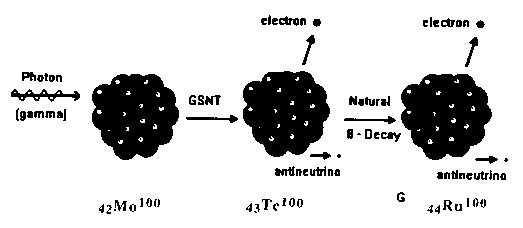
When the original isotope meets the above requirements, it is called hadronic fuel, and the equipment used for its production is called hadronic reactor. [24, 43] It should be stressed that the word "hadronic" here is not intended to strong interactions, but to the use of hadronic mechanics.
As a result of comprehensive studies, Santilli [43] has indicated that most nuclei do not admit stimulated double decays 102) and (103). However, there exists indeed a class of nuclei qualifying as hadronic fuel. AS specific example identified by Santilli in paper [43] of 1994 is given by MO(100, 42, 0) with the following double beta decays
where, by using the data from the Table of Nuclides http://atom.kaeri.re.kr/, we have:
a) Mo(100, 42, 0) is naturally stable with mass 99.9074771 amu;
b) Tc(100, 43) has mass 99.9076576 amu and is naturally unstable with spontaneous decay into Ru(100, 44, 0) and half life of 15.8 s;
c) Ru(100, 44) is naturally stable with mass 99.9042197 amu.
As one can see, the mass of Mo(100, 42, 0) is smaller than that of Tc(100, 43, 1). yet, the conservation of the energy can be verified with a resonating frequency of 0.16803~ MeV (obtained for n = 1/7).
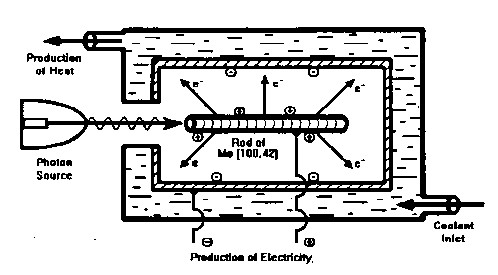
But the mass of the original isotope is bigger than that of the final isotope for a value much bigger than that of the resonating photon. with usable hadronic energy (HE) power nuclear reaction
where Santilli subtracts the conventional rest energy of the two electrons because not usable as a source of energy in this case.
The predicted hadronic energy in this case is two-fold, because we first have the production of heat acquired by the shield capturing the electrons and, jointly, we have the production of a DC electric current between the metal isotope Mo(100, 42, 0) acquiring a positive charge due to the loss of two electrons per reaction, and the metal shield acquiring two negative charges, by keeping into account that each resonating photon produces two electrons.
To appraise the usable energy, let us recall the following units and their conversions 1 amu = 931.494 MeV; 1 MeV = 1.602 x 10⁻¹³ J = 4.45 x 10⁻¹⁷ Wh = 1.511 x 10⁻¹⁶ BTU; 1 Wh = 3.397 BTU; 1 C = 6.241 x 10¹⁸ e; 1 A = 1 C / 1 s, where e is the elementary charge of the electron.
Under the assumptions of using a coherent beam with resonating photons (today produced from synchrotrons of a few meters in diameter) hitting a sufficient mass of Mo(100, 42, 0) suitable to produce 1020 stimulated nuclear transmutations (102) per our, we have the following (see the figure):
Hadronic production of heat: 2 x 10²⁰ MeV/h = 3 x 10⁴ BTU/h,
Hadronic production of electricity: 2 x 10²⁰ e/h = 200 C/h = 55 mA.
Needless to say, the above is merely an illustrative example, with numerous possibilities for improvements, such as the production of much bigger heat via the selection of a heavier hadronic fuel, the increase of the efficiency by adding triggers, etc. In closing this section, we report (following due authorization) the following statement by Prof. Santilli at the end of Section 6.2.13, Volume [24]:
At this point we would like to make a comparison between the first nuclear energy, that predicted by the Italian physicist Enrico Fermi at the University of Rome, Italy, in the 1930s, and the new nuclear energy proposed by another Italian physicist, Ruggero Maria Santilli.
Fermi was forced to work with the theoretical knowledge and technologies of the 1930s essentially consisting of quantum mechanics and the use of neutrons to stimulate {nuclear fission. This resulted in a form of energy, that was indeed historical at the time of its conception, but which is today considered environmentally insufficient due to the production of harmful radiations and the release of radioactive waste. Note that these features are inherent in the selection of {\it heavy nuclei.}\index{Heavy nuclei}
Santilli uses the much more advanced theoretical knowledge of the 21-st century, as well as a variety of new technologies not available during Fermi's times. These new conditions have permitted Santilli to search for new forms of nuclear energies originating from light nuclei, since in the latter case there is no sufficient energy to produce harmful radiation or to leave dangerous waste.
The biggest difference between Fermi's and Santilli's times is, however, the collapse of scientific ethics in academia occurred since the 1930s. This ethical collapse is the primary origin for the lack of solution until now of our alarming environmental problems, the need of surpassing Einsteinian doctrines and quantum mechanics, e.g., via irreversible coverings to achieve a credible representation of notoriously irreversible energy releasing processes, while organized interests in academia strongly opposes the establishing of said covering theories.
In fact, Fermi's rudimentary ideas met with a very receptive, cooperative and supportive scientific environment in the USA, and the rest is well known history. By comparison, Santilli has met to this writing (February 2008) incredible oppositions, obstructions and disruptions in theoretical, let alone experimental studies of possible new energies, as documented beyond "credible" doubt in Refs. [26,27] and in the footnotes of this volume.
It is hoped readers (including academicians) in good faith who care about science and the future of their own children understand the necessity of denouncing these obstructions as organized scientific crimes because clearly damaging the human society, since they manifestly damage the study of much needed new clean energies.
36. Tsagas experiment on the Stimulated Neutron Decay
The experimental verification of stimulated nuclear transmutation (102) was initiated by N. Tsagas and his group [44] at the Nuclear Engineering Department of the University of Thrace, Xanthi, Greece, with preliminary, yet positive results.
The test was conducted quite simply by using a disk of the radioactive isotope Eu(152, 63, 3) as the source of resonating photons placed next to a disk of natural Molybdenum as target while measuring: the background: without any source; the emission with the Europa source alone; and the emission with the joint disks of Europa and natural Molybdenum.
Electrons originating from the Compton scattering of photons with peripheral atomic electrons can at most have 1 MeV energy, as well known. Therefore, the detection of electrons with energy over 2 MeV or more establishes their nuclear origin.
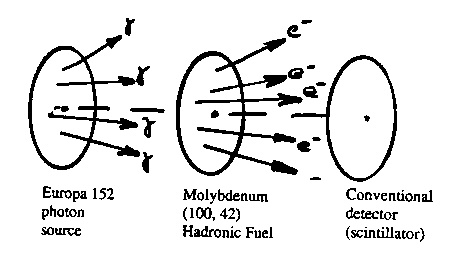
Since the Europa source does not emit electrons, and the Molybdenum is stable, the only possible origin of emitted electrons is due to the stimulated decay of neutrons inside the Molybdenum disk. As recalled earlier, the first reaction (6.2.236a) emits electrons with minimal energy of $2.8 ~MeV$, while the second reaction emits electrons with energy ranging from 2.22 MeV to 3.38 MeV.
It should be indicated that Tsagas?s test [44] has the following limitations [24]:
A) The tests used ordinary Molybdenum, that contains the isotope Mo(100, 42, 0) only in 0.6 %, while all the remaining isotopes of the Molybdenum cannot admit the stimulated decay here considered for various reasons.
B) The primary frequency emitted by the Europa isotope, 1.874 MeV, is not the resonating frequency that should instead be 1.294 MeV less the correction due to the nuclear binding energy, although Eu(152, 63, 3) does emit a number of additional photons, one of which has the energy of 0.148 MeV close to the subharmonic of the resonating energy.
C) The tests solely used detectors of the energy of the emitted particle, without additional detectors for the identification of their nature.
Under these conditions, the possibilities of achieving reaction (102) are rather limited. Yet Tsagas did indeed report the detection of emissions in the sole Eu-Mo coupling in excess of 1 ~ MeV, as shown in the figure below.
In summary, far from being final, Tsagas tests remain the first experiment on Santilli's hadronic energy and, despite their limitations, they were indeed positive.
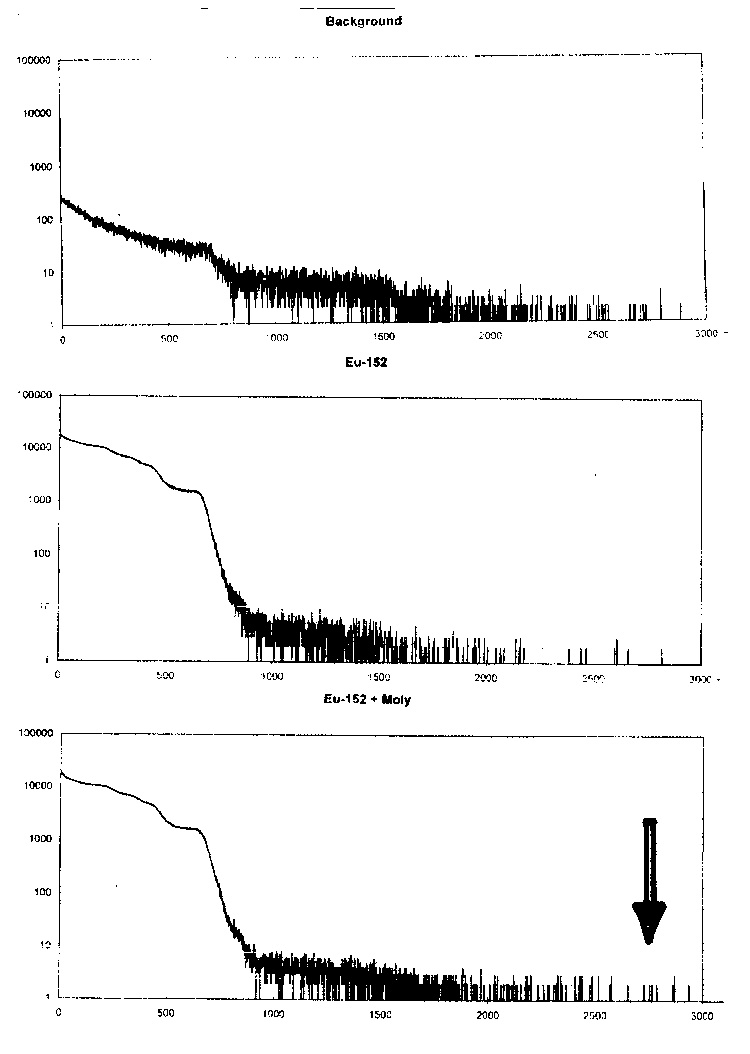
37. Santilli Experiment on the Stimulated Neutron Decay
Following Tsagas experiment [44] of 1996, Santilli proposed for over one decade its repetition to numerous nuclear physics laboratories around the world, with the same results as those of the proposed experiment on the neutron synthesis, namely, obstructions and disruptions.
Hence, Santilli had no other choice than that of conducting the experiment with his technicians at the laboratory of the Institute for Basic Research in Florida.
Santilli's experiment is done via: 1) The use of a pure isotope of Mo(100, 42, 0); 2) The use of radioactive isotopes having the correct resonating frequency; 3) The use of energy measuring detectors; 4) The use of additional particle detectors; and 5) Conducting the test with and without additional triggers besides the resonating frequency.
Regrettably, Santilli has not received authorization by the funding industry to disclose details and results due to the ongoing collapse of ethics in academia. However, the test was indeed successful and did indeed improve the Tsagas results as expected from the selection of the proper isotope and the proper resonating frequency. What cannot be disclosed because of novelty opposed by academia is the additional trigger used for the test.
38. Recycling of radioactive nuclear waste via their stimulated decay
One of the most important implications of Santilli's studies on the structure, synthesis and stimulated decay of the neutron is their application to the recycling of highly radioactive nuclear waste via its stimulated decay. Predictably, optimal results are expected via the combined use of additional methods and processes, some already patented (see http://www.nuclearwasterecycling.com and the beautiful presentation by Prof. J. Dinning-Davies from England [45]).
Most importantly, the equipment is sufficiently small to be usable by the nuclear power plants themselves, thus avoiding the very da ngerous and extremely expensive transportation of the waste to depositories for our descendants to recycle.
The implications are here far reaching because, on one side conventional nuclear power plants can become environmentally more acceptable while., on the other side, we can have the birth of a new multi-billion dollar industry.
Unfortunately, Prof. Santilli received life threats for his studies on recycling nuclear waste and has formally stated in Vol. [24], Section 6.2.16, that he does not intend to conduct additional research in the field. Apparently, Prof. Santilli is not the only one to have received life threats for serving society, because a similar occurrence has been experienced by numerous other scientists who worked at the recycling of nuclear waste, the saddest aspect being the lack of interest by the U. S. senate in conducting investigations of something so serious and so damaging to the country. In the final analysis, one should remember the assassination of Eugene Mallove, Founder of Infinite Energy and a great proponent of new energies, which assassination is still full of misinformation without a clear solution.
The following statement by Prof. Santilli from Volume [24], Section 6.2.16 may illustrate the situation:
To give an idea of the organized scientific crime in the field, the reader in good faith should be aware that Santilli and his wife Carla organized some 18 international meetings in three continents. In 1998 they decided to organize a World Congress on Recycling Nuclear Waste to gather all the best scientists in the field and identify the needed research.
For that purpose the Santillis did set up the Scientific Committee one can see in web site http://www.i-b-r.org/ir00016.htm and attempted to organize the conference at the Nuclear Physics Department of the University of Florida in Ganeisville. Rather than assisting in the organization of a conference with such a transparent societal and environmental relevance, the outcome was such to discourage any additional attempt at organizing the conference anywhere in the USA, outcome that included the loss of a permanent job by a leading member of the Scientific Committee at a leading national laboratory.
Then, the Santillis attempted the organization of the same meeting in Europe by contacting the director of the time of the appropriate branch of the European Community in Bruxelles, C. Routti director of the EC XIi Division. Routti's behavior was so repulsive and obstructive to prevent any attempt at organizing the conference anywhere in Europe.
The announcement of the World Congress on Recycling Nuclear waste for the year 2000 has been left in the web site http://www.i-b-r.org/ir00016.htm as a documentation of the the fact that the lack of solution of the increasingly alarming environmental problems is due to a world wide collapse of ethics.
39. Nuclei as hadronic bound states of protons and electrons
Since stars initiate their lives as being solely composed of hydrogen, with the proton and the electron as permanently stable constituents, the first hypothesis on the structure of nuclei in the early part of the 20-th century was that nuclei are composed of protons and electrons.
As it was the case for the structure of the neutron, the advent of quantum mechanics caused the rejection of the above plausible conception, due to the impossibility of a quantum representation of basic nuclear characteristics, including spin, mass, magnetic moments, etc.
The theological argument, still standing in full force nowadays in academia, is that quantum mechanics is exact in nuclear physics. Hence, nature must be adapted to comply with said theology. Since the electron as a physical constituent of nuclei is not admitted by the theology, it does not exist in nuclei. The search for a broadening of quantum mechanics to represent evidence cannot be admitted due to consequential billions of dollars losses by academia in research contracts.
By contrast, Santilli ignored all this political conduction of basic research and conducted studies of the following evident historical relevance [21-25, 46]:
1) He established the lack of exact character of quantum mechanics in nuclear physics for a large variety of technical arguments, including the impossibility for the basic symmetries of the atomic structure to be exact for the nuclear structure since "nuclei do not have nuclei" as it is the case for atoms;
2) He then launched in 1978 the construction of the covering hadronic mechanics particularly applicable to the nuclear structure, thanks to contributions from mathematicians, theoreticians and experimentalists around the world.
3) He then conducted comprehensive studies on the structure, synthesis and decay of the neutron. whose major outcome is that hadronic mechanics has permitted the numerically exact and time invariant representation of "all" characteristics of the neutron as a a hadronic bound state of a proton and a neutron, an achievement that is not even partially possible with quantum theologies.
Once neutrons are been reduced to protons and electrons, a historical implications of the above studies is that nuclei are a "hadronic" bound state of protons and electrons. Since quantum mechanics remains approximately valid in nuclear physics (see Section 7), the representation of nuclei as "quantum" bound states of protons and neutrons remains valid, but only as an approximation of Santilli's deeper structure, where the words "hadronic" and "quantum" refers to the applicable mechanics.
The above new vistas have been applied to the structure of the deuteron [24,46] that now becomes a three-body systems. In fact, the deuteron results as being a hadronic bound state of two protons and one electron, which structure can be interpreted in first approximation as being composed of one proton and one neutron.
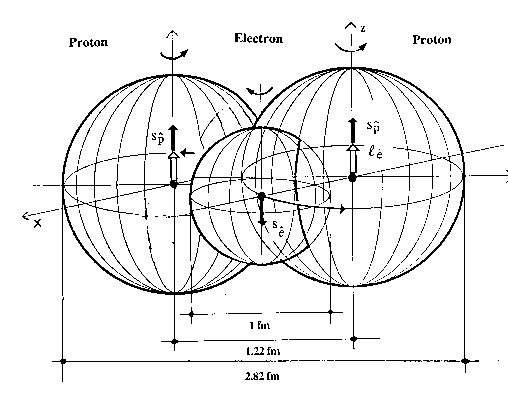
It is important to know that hadronic mechanics achieved for the first time the representation of all characteristics of the deuteron from first principle without manipulations. a feature proved to be impossible for quantum mechanics. In fact (see Refs. [24,46] for technical details):
1) Quantum mechanics has been unable to represent the spin 1 of the ground state of the deuteron, while such a representation via hadronic mechanics is immediate. The basic axioms of quantum mechanics require that the most stable bound state of two particles with spin 1/2 is that with spin zero (singlet coupling or antiparallel spin) because spin 1 (parallel spin coup[ling) cases very strong repulsiveforces. Therefore, quantum mechanics has been unable to represent the spin 1 of the ground state of the deuteron. By comparison, such a representation is direct and immediate with hadronic mechanics (see Ref. [46] for brevity). As a matter of facts, the spin 1 of the ground state of the deuteron is a direct and incontrovertible evidence that it is a "three-body system" and definitely not a two-body system as believed in nuclear physics prior to Santilli. In fact, the three-body system is the only one resolving the huge inconsistency of quantum mechanics for which the deuteron cannot be stable since spin 1 mandates parallel spins of the proton and t he neutron with consequential strongly repulsive forces.
2) Quantum mechanics has been unable to represent the stability of the deuteron, while its representation via hadronic mechanics is immediate. In fact, the neutron is naturally unstable and, thus, for quantum mechanics, the deuteron should be unstable too. In the otherwise vast nuclear physics literature there exist no credible proof via quantum mechanics of the stability of the deuteron. The representation of such a stability via hadronic mechanics is instantaneous because protons and electrons are indeed stable. The stability of the deuteron is then reduced to the simple task of selecting a stable orbits.
3) Quantum mechanics has been unable to reach an exact representation of the magnetic moment of the deuteron, while hadronic mechanics has produced a numerically exact and time invariant representation. After several decades of research, nonrelativistic quantum mechanics misses 0.022 Bohr units in the representation of the deuteron magnetic moment corresponding to 2.6 % of the experimental value. Relativistic corrections reduce the error down to about 1 % but under highly questionable theoretical assumptions and manipulations to adapt nature to Einsteinian theories, such as the use for ground state of a mixture of different energy levels (!!!) that are assumed to coexist without any emission or absorption of quanta as requested by quantum mechanics. Embarrassing deviations occur for the magnetic moments of heavier nuclei. The reduction of the deuteron and other nuclei to the hypothetical quarks multiplies the problems and resolve none because the presumed orbits of the hypothetical quarks are too small to be polarized. Following the exact representation of the magnetic moment of the neutron (Section 26), the exact representation of the magnetic moment of the deuteron and of other nuclei is elementary [24,46].
4) Quantum mechanics has been unable to identify the physical origin of the attractive force binding together the proton and the neutron, while hadronic mechanics has achieved its explicit and concrete identification. Since the neutron is neutral, there is no known electrostatic origin of the attractive force needed for the existence of the deuteron. As a matter of fact, the only Coulomb force for the proton-neutron system is that of the magnetic moments, which force is repulsive for the case of spin 1 (with parallel spin). Therefore, new interaction of unknown origin, the "strong interactions," were conjectured and maintained to this day, although the words "strong interactions" remain a pure nomenclature when compared to the "electromagnetic interactions" since the latter have a clear and fully identified physical origin while the former have absolutely none. Particularly mysterious remain the "exchange forces," namely, forces conjectured to originating from the exchange of protons and neutrons. All these unsolved aspects receive a direct, numerical and invariant resolution by hadronic mechanics. In fact, the force of the deuteron is physically the same as that for the structure of the neutron, namely, it is not derivable from a potential, thus requiring a representation with anything except the Hamiltonian (Section 26). Hadronic mechanics represents the strong force with a lifting of the basic unit as the only known way to achieve invariance under no potential. The proton-neutron exchange is also elementary and due to the exchange of the electron between the two isoprotons apparently according to an "o-o type orbit" that assures stability. In this way the proton and the neutron continuously interchange each other, and the interchange does indeed produce a physically identified force well known in molecular physics.
5) Quantum mechanics has also been unable to treat the deuteron space parity in a way consistent with the rest of the theory, while said parity is quickly represented by hadronic mechanics. The experimental value of the space parity of the deuteron is positive for the ground state, because the angular momentum L is null. However, in the dream of achieving compatibility of the deuteron phenomenology with quantum mechanics, nuclear physicists assume for the calculations that the ground state is a mixture of the state with L = 0 with other states in which the angular momentum is not null, thus implying an embarrassing inconsistency that it is simply ignored in nuclear physics, although well known by experts to qualify as such, in evident support of organized interests on Einstein theories and quantum mechanics. The solution with hadronic mechanics is also elementary because the spin 1 is now referred to a three-body system whose ground state has indeed the correct parity (see again [24,46] for brevity.
In closing, the insufficiencies of quantum mechanics for a serious representation of the structure of the deuteron are truly embarrassing. But the deuteron is the smallest among all nuclei. When passing to bigger nuclei, the deviations of quantum mechanics from reality increase so much to assume simply astonishing character, as it is the case for heavy nuclei such as the Americium.
When this plethora of insufficiencies or sheer inconsistencies of quantum mechanics in nuclear physics is compared to the religious belief in the exact character of Einstein theories and quantum mechanics in the field, one can understand Prof. Santilli's view that nuclear physics is one of the most corrupt sciences in history because notorious insufficiencies are systematically ignored, while fanatically opposing any search for more adequate covering theories.
40. Backward and forward closing comments
By looking in retrospect, it is hoped the reader can now see the need to reach a technical knowledge the implications of hadronic mechanics all the way to nuclear physics prior to venturing judgments in the structure, synthesis and stimulated decay of the neutron.
By looking forward, the reader should be aware that, besides the above outline at the level of neutrons and nuclei, hadronic mechanics has permitted historical advances in chemistry, such as [18]: the first known exact and invariant representation of all characteristics of the hydrogen, water and other molecules from first principles without throwing in unknown functions fitted from the data; the discovery of a new chemical species today known as "Santilli magnecules"; the development of a new class of fuels with complete combustion; and other basic advances now seeing large industrial investments in three continents (see, for instance, http://www.magnegas.com).
In particular, the hadronic energy reviewed above is only the first of three classes of new energies, the remaining two being at the nuclear and molecular levels. In fact, Santilli (Volume [24], Section 6.2.13D) defined as "hadronic energy" any new form of energy at the particle (Class I), nuclear (Class II) and molecular (Class III) levels that is not predicted by quantum mechanics but predicted and quantitatively treatable via hadronic mechanics.
In particular, scientists and industries seeking new nuclear energies, such as the "cold" and the "hot" fusions, should be warned that they can ignore hadronic mechanics at their own peril because hadronic mechanics has identified seven physical laws that have to be obeyed for two nuclei to fuse into a third [47]. To the author best knowledge, all current attempts at the "cold" and 'hot" fusion violates one or more of the hadronic laws. This provides a quantitative understanding of their lack of achievement of industrial relevance until now, as well as specific and detailed procedures for their resolution. At any rate, following the publication of paper [47], no theoretical or experimental study or investment in the "cold" and "hot" fusions can be considered serious unless Santilli's results [47] are either accepted, or disproved in refereed journals.
We cannot possibly review these additional vistas in this article. Nevertheless, in the event of a constructive reception of this first article with the necessary containment of the ongoing asocial and ascientific greed on Einsteinian theories and quantum mechanics, we shall gladly submit to PESWIKI additional articles on the new hadronic energies of Class II and III for interested scientists and industries to develop further because, in the final analysis (to paraphrase again Prof. santilli), "our scientific knowledge is at its beginning and so much remains to be discovered."
41. Criticisms of hadronic mechanics and their lack of credibility
The author has conducted extensive search via electronic means as well as consultations with various colleagues to identify all criticisms on Santilli's hadronic mechanics that have appeared in print in some scientific conduit, thus ignoring criticisms on electronic chat boards because, due to their lack of formulae for quantitative analyses, they have no serious scientific value of any type. To his surprise, the author has located only the following very few criticisms on record.
The first criticism appearing in the web following a search under "hadronic mechanics" is that by wikipedia in the website
http://en.wikipedia.org/wiki/Ruggero_Santilli
Ruggero Maria Santilli (born 1935) is an Italian-American physicist and a proponent of fringe scientific theories.
It is clear that the anonymous (but well known) editors of wikipedia wanted to qualify as "fringe science" Prof. Santilli's main studies via hadronic mechanics, those on the synthesis of the neutron as occurring in stars, evidently because contrary to notorious organized interests on Einsteinian theories and quantum mechanics. The author then conducted a search in wikipedia under quark conjectures, multidimensional theories, various multiple hyperbolic particles, and other farfetched of speculations and, as expected, did not find any dubbing of "fringe science". As a matter of fact, the sole use of "fringe science" in wikipedia appears to be that for Prof. Santilli's research, thus disqualifying wikipedia for any scientific credibility.
In fact, wikipedia claims to be a "free" encyclopedia. Thus, Prof. Santilli did edit a few presentations in wikipedia with the addition of the words "fringe science" when treating theories that verify quite brutally all Theorems of Catastrophic mathematical and Physical Inconsistencies of Noncanonical and Nonunitary Theories. As expected, the wikipedia editors immediately erased Prof. Santilli's editing and restored the original scientific farce of presenting research via the studious suppression of its inconsistencies, thus exposing the farce implied by the posturing as "free encyclopedia."
Next, the author has been told, but could not identify the printed source, that A. Fox and his assistant R. Jin published in 1999 in their Journal of New Energies (owned and edited by A. Fox) a paper criticizing the Santilli-Shillady isoelectronium [48] as being impossible on numerous arguments. For the record, we are here referring to the two historical papers [48] published by the International Journal of Hydrogen Energy of Oxford, England, following one year of technical review, which papers presented the first quantitative representation of the ATTRACTIVE FORCE in valence electron bonds that permitted the only known exact representation of molecular binding energies from unadulterated first principle.
Santilli-Shillady isoelectronium has essentially the same structure of the Rutherford-Santilli neutron, and uses most of the underlying formalism, consequently being an unstable bound state of two electrons in deep mutual penetration in singlet couplings as in the figure of Section 18.
\
Fox and Jin criticized the Santilli-Shillady isoelectronium on grounds that two electrons cannot bond into each other via the sole use of quantum mechanical laws. Prof. Santilli was invited by Mr. Fox to publish a rebuttal but he refused because the criticism was unethical on various grounds, such as:
1) Fox and Jin used the laws of quantum mechanics to criticize s bound states crucially based on the covering laws of hadronic mechanics, which is indeed unethical scientific conduct because it would be like claiming that the hydrogen atom cannot exist based on the laws of hadronic laws.
2) Valence electrons do indeed bond in nature and do indeed bond into an unstable quasiparticle as established beyond doubt by the very existence of molecules. Assuming that Fox and Jin were disturbed by the beautiful advances of papers [48], rather than criticizing the first quantitative treatment of molecular bonds, they should have instead presented their own. Evidently, they did not have the necessary technical knowledge and, consequently, they merely criticized results [48] without any technical foundation.
3) Prof. Santilli delivered a detailed presentation of hadronic mechanics at the 1998 meeting on new energies organized by Mr. Fox who published the 318 pages presentation in his journal, Ref. [17], following a personal review (the author has seen the draft of book [17] with Mr. Fox's markings). Hence, Fox and Jin cannot credibly deny knowledge of the vast arguments according to which quantum mechanics is not necessarily exact at the mutual distances of the Santilli-Shillady isoelectronium (1 fm = 10-13 cm), in the same way as hadronic mechanics recovers quantum mechanics identically for all mutual distances of particles bigger than 1 fm.
In reality, papers [48] were published in one of the most prestigious refereed journals in chemistry; Prof. Santilli is a former member of the Department of Mathematics of Harvard University under DOE support; and Prof. Shillady is a senior U. S. academic chemist. By comparison, A. Fox has no formal education and that by R. Jin is unknown. hence, the Fox-Jin criticism here considered must de denounced as arrogant and unethical.
A third and final; criticism the author could identify is that by Calo [49] who published a very violent and personal attack against Prof. Santilli for his hypothesis of the new chemical species of magnecules, with particular reference to another historical article by Prof. Santilli, Ref. [50] on a new gaseous and combustible form of water he called HHO.
In essence, we are referring to a gaseous form of water obtained from distilled water via a new electrolyzer (not treated by Prof. Santilli) that exhibits very anomalous features, such as the capability of instantly melting tungsten and bricks. A similar gas is known as "Brown gas," but the latter is specifically referred to an exact stochiometric mixture of 2/3 H2 and 1/3 O2. Prof. Santilli provided the first quantitative study that said mixture of hydrogen and oxygen cannot instantly cut tungsten and bricks; showed the need for the presence in the gas not only of hydrogen atoms, but in actuality hydrogen atoms with a special polarizations of their orbitals that could only exist under the new species of magnecules; and presented a rather impressive body of experimental evidence in support of his studies.
Unlike Fox and Jin, Calo is a senior academic chemist at Brown University, Providence, RI. Hence, his criticisms carry significant financial weight at U. S. federal agencies granting research funds. According to an unverifiable but quite plausible rumor, Calo's criticism had been commissioned by organized interests in quantum chemistry. The problem for Calo and for his friends is that the criticisms had no technical foundations whatsoever and were solely based on an incredible ignorance of the field by Calo to the incredible extreme of being openly admitted. At any rate, Calo's criticisms were demolished as purely political by Cloonan [51], an academic chemist from Ireland, Kadeisvili [52], a [physicist from the (Russian) Georgia, and Trell [53], a scientist from Sweden.
The author would appreciate being informed of any additional criticism on hadronic mechanics and chemistry that may have appeared in print in scientific conduits, thus excluding again criticisms in electronic chat boards that have no serious scientific value.
42. Acknowledgments
The author has no words to thank Prof. R. M. Santilli for allowing him to freely copy his works, for invaluable explanations, and for a review of the paper. The author would like also to thank numerous colleagues for comments, with particular reference to Prof. Horst Wilhelm for a very accurate inspection of the entire manuscript. It is clear that the author is so;lely responsible for the content of the paper due to numerous changes in the final version.
NOTE ADDED IN PROOF: Identification of isoquarks as physical particles
POne of the major (unpublished) criticism oif the Rutherford-Santilli neutron is that, while being compatible with the SU(3)-color classification of hadrons, it is not compatible with the the structure of hadrons according to the standard model for which the neutron is composed of
three quarks,
with the known colors here omitted for brevity.
While this article was in press, Prof. Santilli sent to the author the draft of his paper [54] in which he shows that, as conventionally formulated, the indicated problem is essentially due to basically insufficient mathematics and, when a more adequate mathematics is used, the problem does not exist.
As now familiar, the mathematics for point-like abstraction of particles moving in vacuum should be replaced with the covering Santilli isomathematics for extended particles immersed within hyperdense media. This means that model (107) is utterly approximate due to the necessity to abstract quarks as points in order to maintain the validity of quantum mechanics.
Hence, Prof. Santilli's first step in paper [54] is the lifting of the excessively approximate model (107) into a more adequate model based on iso-Hilbert spaces on isofields, for which quarks are lifted into isoquarks
with a number of structural changes we cannot report here for brevity, while preserving the original, SU(3)-color symmetry (something guaranteed bv the transition from the conventional Lie to the covering lie-Santilli isotheory).
Next, Prof. Santilli recalls that the protons and the electron, when immersed within the hyperdense medium inside the neutron cannot have the conventional characteristics in vacuum, because they are lifted by the immersion into isoprotons p* and isoelectron e*.
The final contribution of paper [54] is the identification of model (108) with the full hadronic model
where a* is Santilli's etherino.
The implications of the above identification are far reaching because it simply obliterates all controversies on quarks, such as those on the impossibility for a true quark confinement, the absence of gravity, the lack of inertia, etc. All these objections are eliminated when quarks are treated with the proper mathematics in which case, and only in which case, they can be identified with actual physical particles produced free in the spontaneous decay, merely experiencing a mutation from their conditions in vacuum due to their immersion within the hyperdense medium inside the neutron.
Needless to say, the mental attitude needed to eliminate the now vexing problems on conventional quark conjectures is Prof. Santilli well known statment in most of his works, namely, the admission that the mechanics exactly valid for an electron orbiting in vacuum in the hydrogen atom, simply cannot be exactly valid for the same electron when totally immersed inside the proton due to abyssal physical differences of the two conditions.
The final mental attitude needed to eliminate now vexing problems on quark conjecture is the admission of scientifoic evidence, namely, that Santilli's hadronic mechanics is the only known mechanics that is directly universal for the conditions considered, axiomatically consistent and time invariant.
Hence, the decision that has been in front of the physics community for over thirty years (since proposal [6.7] of 1978 to build hadronic mechanics) is whether to maintain pre-existing doctrines for personal gains, and risk a historical condemnation in the process, or admit incontrovertible physical evidence and allow basic human knowledge to move forward, particularly in view of the compelling need for new clean energies and fuels that are notoriously impossible for old theoretical theologies, while being predicted and quantitatively treated by broader theories.
REFERENCES
[1] H. Rutherford, Proc. Roy. Soc. A, 97, 374 (1920)
.
[2] J. Chadwick, Proc. Roy. Soc. A, 136, 692 (1932).
[3] W. Pauli, Handbuch der Physik, Vol. 24, Springer-Verlag, Berlin (1933).
[4] E. Fermim Nuclear Physics, University of Chicago Press (1949).
[5] Ruggero Maria Santilli, "Imbedding of Lie algebras in nonassociative structures,"
Nuovo Cimento 51, 570-576 (l967), and "An Introduction to Lie-admissible Algebras," Supplemento al Nuovo Cimento 6, 1225 (l968).
[6] R. M. Santilli, "On a possible Lie-admissible covering of the Galilei
Relativity for nonconservative and Galilei form-noninvariant systems,"
Lyman Laboratory of Physics, Harvard University, Cambridge MA, under DOE contract DE-ACO2-80ER-10651.A001, published in the
Hadronic J. 1, 223-423 (l978), with addendum published in the Hadronic Journal 1, 1279-1342
(l978) (this memoir set the mathematical foundations of hadronic mechanics)
[7] R. M. Santilli, "Need for subjecting to an experimental verification the validity within a hadron of Einstein's Special Relativity and Pauli's Exclusion Principle," Lyman Laboratory of Physics, Harvard University, Cambridge, MA, under DOE contract DE-ACO2-80ER-10651.A001, published in the
Hadronic J. 1, 574-902 (l978) (this memoir originated the construction of hadronic mechanics).
[8] R. M. Santilli, Foundations of Theoretical Mechanics,
Volume I:
The Inverse Problem in Newtonian Mechanics,
in the series Text and Monographs in Physics,
Springer-Verlag, Heidelberg, Germany (1978)
[9] R. M. Santilli, Foundations of Theoretical Mechanics,
Volume II:
Birkhoffian Generalization of Hamiltonian Mechanics,
In the series Text and Monographs in Physics,
Springer-Verlag, Heidelberg, Germany (1982).
[10] R. M. Santilli, Lie-admissible Approach to the Hadronic Structure,
Volume I:
Nonapplicability of the Galilei and Einstein Relativities?
in the series Monographs in Theoretical Physics,
Hadronic Press, Palm Harbor, Florida (1978).
[11] R. M. Santilli, Lie-admissible Approach to the Hadronic Structure,
Volume II:
Coverings of the Galilei and Einstein Relativities?
in the series Monographs in Theoretical Physics,
Hadronic Press, Palm Harbor, Florida (1981)
[12] R. M. Santilli, Isotopic Generalizations of Galilei and Einstein
Relativities,
Volume I:
Mathematical Foundations,
Hadronic Press, Palm Harbor, Florida (1991).
[13] R. M. Santilli, Isotopic Generalizations of Galilei and Einstein Relativities,
Volume II:
Classical Formulations,
Hadronic Press, Palm Harbor, Florida (1991).
[14] R. M. Santilli, Elements of Hadronic Mechanics, FL
Volume I:
Mathematical Foundations,
Naukova Dumka, Ukraine Academy of Sciences, Kiev
(second edition 1995).
[15] R. M. Santilli, Elements of Hadronic Mechanics,
1994 Volume II:
Theoretical Foundations,
Naukova Dumka, Ukraine Academy of Sciences, Kiev
(second edition 1995).
[16] R. M. Santilli, Isotopic, Genotopic and Hyperstructural Methods in
Theoretical Biology,
Ukraine Academy of Sciences, Kiev (1996).
[17] R. M. Santilli, The Physics of New Clean Energies and Fuels According to
Hadronic Mechanics,
Special issue of the Journal of New Energy, 318 pages (1999).
[18] R. M. Santilli, Foundations of Hadronic Chemistry with Applications to New
Clean Energies and Fuels,
Kluwer Academic Publishers, Boston-Dordrecht-London, 397 pages (2001);
Russian Translation available in pdf-zip format at
http://i-b-r.org/docs/sanrus.pdf.zip
[19] R. M. Santilli, Iaodual Theory of Antimatter and its application to Antigravity,
Grand Unifications and Cosmology, Springer (2006)
[20] R. M. Santilli, New Structure Models of Hadrons, Nuclei and Molecules as Permitted by Hadronic Mechanics, their Experimental Verifications and Industrial Applications, website http://www.neutronstructure.org (2003).
[21] R. M. Santilli, Hadronic Mathematics, Mechanics and Chemistry,
Volume I:
Limitations of Einstein's Special and General Relativities,
Quantum Mechanics and Quantum Chemistry, available as a free download in pdf from the website http://www.i-b-r.org/Hadronic-Mechanics.htm
[22] R. M. Santilli, Hadronic Mathematics, Mechanics and Chemistry,
Volume II:
Isodual Theory of Antimatter,
Antigravity and Spacetime Machines available as a free download in pdf from the website http://www.i-b-r.org/Hadronic-Mechanics.htm
[23] R. M. Santilli, Hadronic Mathematics, Mechanics and Chemistry,
Volume III:
Iso-, Geno-, Hyper-Formulations for Matter
and Their Isoduals for Antimatter available as a free download in pdf from the website http://www.i-b-r.org/Hadronic-Mechanics.htm
[24] R. M. Santilli, Hadronic Mathematics, Mechanics and Chemistry,
Volume IV:
Experimental Verifications, Theoretical Advances and
Industrial Applications in Particle Physics, Nuclear Physics and Astrophysics available as a free download in pdf from the website http://www.i-b-r.org/Hadronic-Mechanics.htm
[25] R. M. Santilli, Hadronic Mathematics, Mechanics and Chemistry,
Volume V:
Experimental Verifications, Theoretical Advances
and Industrial Applications in Chemistr available as a free download in pdf from the website http://www.i-b-r.org/Hadronic-Mechanics.htm
[26] R. M. Santilli, Ethical Probe of Einstein's Followers in the
U.S.A.: An Insider's View, Alpha Publishing, Newtonville, MA (1984), ISBN 0-931753-00-7, available as free download in pdf format in the web site
http://www.scientificethics.org/IlGrandeGrido.htm
[27] R. M. Santilli, Documentation of the Ethical Probe, Volumes
I, II and III, Alpha Publishing,
Newtonville, MA (1986), available as free download in pdf format from the web site
http://www.scientificethics.org/IlGrandeGrido.htm
[28] A. K. Aringazin, A. Jannussis, D. F. Lopez, M. Nishioka and B. Veljanosky,
Santilli's Lie--Isotopic Generalization of Galilei's Relativities,
Kostarakis Publisher, Athens, Greece (1980).
[29] J. V. Kadeisvili, Santilli's Isotopies of Contemporary Algebras, Geometries and Relativities, Ukraine Academy of Sciences, Kiev, 2nd edition {1995}.
[30] Gr. Tsagas and D. Sourlas, Mathematical Foundations of the Lie-Santilli Theory, Ukraine Academy of Sciences, Kiev (1993).
[31] J. Lohmus, E. Paal and L. Sorgsepp,
Santilli Nonassociative Algebras in Physics, Hadronic Press, Palm Harbor, FL, (1994).
[32] R. M. Falcon Ganfornina and J. Nunez Valdes, Fondamentos
de la Isoteoria de Lie-Santilli, (in Spanish) International
Academic Press, America-Europe-Asia, (2001), also available in
the pdf file http://www.i-b-r.org/docs/spanish.pdf
[33] Chun-Xuan Jiang, Foundations of Santilli's Isonumber
Theory, International Academic Press,
America-Europe-Asia (2002), also available in the pdf file
http://www.i-b-r.org/docs/jiang.pdf.
[34] R. M. Santilli, Lie-admissible invariant representation of irreversibility for matter and antimatter at the classical and operator levels, Nuovo Cimento 21 B, 443 (2006).
[35] R. M. Santilli, Hadronic J. 13, 513 (1990).
[36] R. M. Santilli, Communication of the Joint Institute for Nuclear Research, Dubna, Russia, number JINR-E4-93-352 (1993)
[37] R. M. Santilli, Chinese J. Syst. Eng. and Electr. and Electronics. 6, 177 (1996).
[38] R. M. Santilli, "The etherino and/or the neutrino hypothesis," Foundation of Physics 37, 670 (2007).
[39] C. Borghi, C. Giori C. and A.~ Dall'Olio, Communications of CENUFPE, Number 8 (1969) and 25 (1971),
[40] C. Borghi, C. Giori C. and A.~ Dall'Olio,(Russian) Phys. Atomic Nuclei, 56, 205 (1993).
[41] R. M. Santilli, ``Apparent confirmation of Don Borghi's experiment toward the synthesis of neutron from protons and electrons," Hadronic Journal 30, 709 (1997).
[42] R. M. Santilli, The synthesis of the neutron according to hadronic mechanics and chemistry," Journal Applied Sciences, in press (2006).
http://www.neutronstructure.org/neutron-synthesis.htm
[43] R. M. Santilli, Hadronic J. 17, 311 (1994).
[44] N. F. Tsagas, A. Mystakidis, G. Bakos, and L. Seftelis, Hadronic J. 19, 87 (1996).
[45] J. Dunning-Davies, Exploding a Myth, Conventional Wisdom or Scientific Truth? Horwood (2007).
[46] R. M. Santilli, The Structure of the Neutron According to Hadronic Mechanics,
http://www.neutronstructure.org/neutron-synthesis.htm
[47] R. M. Santilli, "The novel 'Intermediate Controlled Nuclear Fusion' and its industrial realizagtion as pedicted by hadronic mechanics and chemistry", Journal of Applied Sciences, 23, 47 (2004).
[48] R. M. Santilli and D. D. Shillady, Intern. J. Hydrogen Energy
24, 943 (1999), and 25, 173 (2000).
[49] J. M. Calo, International Journal Hydrogen Energy, 32, p. 1309 (2007) for free downlowd
Calo Nonscientific Nonsense;
[50] R. M. Santilli, ``A new gaseous and combustible form of water", Intern. J. Hydrogen Energy,
<3> 31, 1113 (2006).
[51] M. O. Cloonan, International Journal Hydrogen Energy 33, p. 922 (2008), for free download
Coonan Scientific response
[52] J. V. Kadeisvili, International Journal Hydrogen Energy, 33, p. 918 (2008) for free download
Kadeisvili scientific response
[53] E. trell, International Jpournal Hydrogenb Energy 28, p. 251 (2003), for free dowmload
Trell review of Hadronic Chemistry
[54] R. M. Santilli, "Identification of isoquarks with physical particles in our spacetime," in press at the Hadronic Journal, 31> (2008).
Copyrighted ©
Decxember 3, 2007 by the Institute for Basic Research, P. O. Box 1577, Palm Harbor, FL, 34683, USA. Revised January 14, 2008, march 22, 2008.
All Rights Reserved.
LEGAL; NOTICE: All electronic links to this IBR copyrighted web site are hereby authorized without any need of further confirmation PROVIDED that its URL is not adulterated. Any reproduction of this web site and/or of its content without identification of paternity will be considered copyright infringement and/or paternity fraud and will be prosecuted in court (see the International Committee for Scientific Ethics.